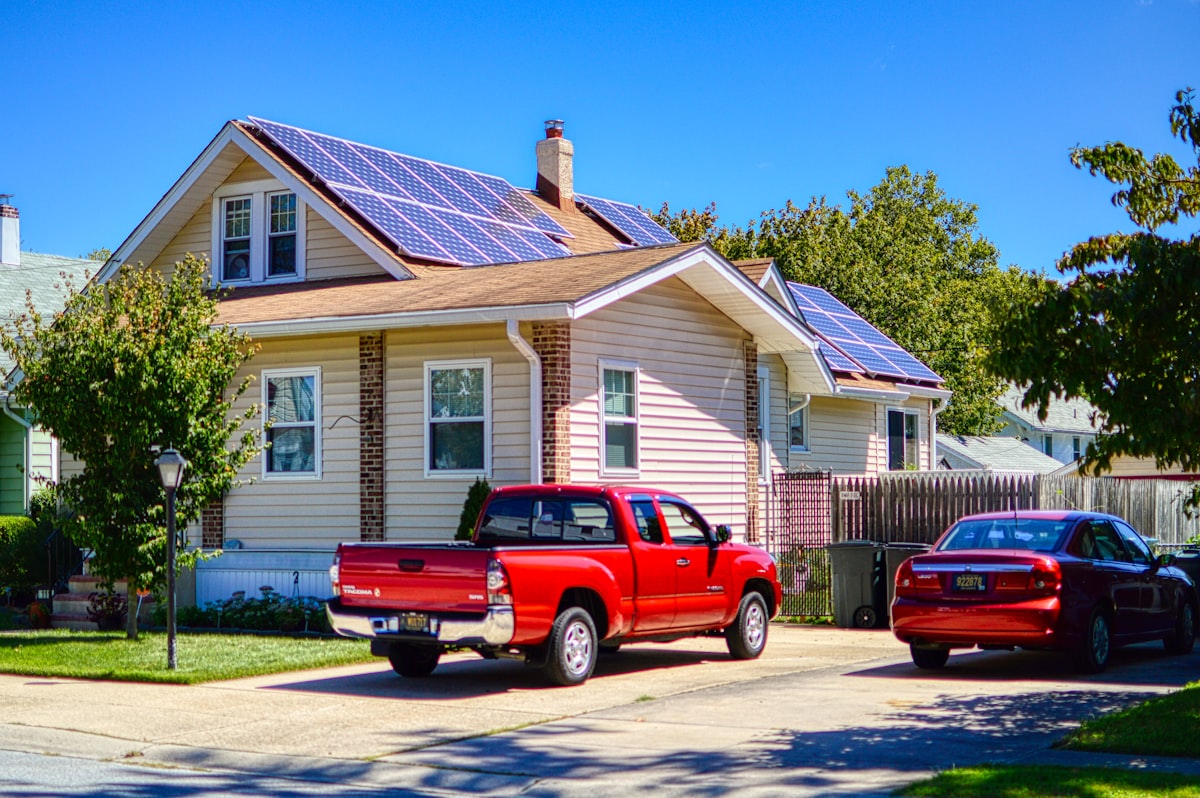
Solar EV Charging in Nigeria: The Numbers That Make It Work
Nigeria has more sun than Germany and more power outages than patience. Here is exactly how many panels, what size inverter, and how much money you need to charge your EV entirely from solar.
The generator is running. Again.
It is 11 PM in Lekki Phase 1 and Chukwuemeka has just plugged in his BYD Dolphin. His diesel generator hums outside the gate, burning fuel to charge a car he bought specifically to stop burning fuel. Somewhere in this equation, something has gone wrong. It did not have to be this way.
Nigeria generates only 4,000 to 4,500 MW of electricity against a national demand of approximately 30,000 MW. The grid delivers 8 to 14 hours per day in the best areas, and many households get fewer than 4 hours. Six grid collapses were recorded in 2023 alone. You already know this. You have lived it.
What most people do not know is that Nigeria averages 6 to 9 peak sun hours per day depending on your city. Lagos sits at the lower end with 6 hours. Abuja gets 7 to 8. Kano and Kaduna push 8 to 9. For comparison, Germany, the country that built the most solar panels in the world, averages just 3 to 4 peak sun hours. The sun is one resource Nigeria has in abundance, and a solar-charged EV is how you turn that into free kilometres.
The State of Charging in Nigeria Right Now
As of late 2024, there were only 12 public EV charging stations in the entire country. That is not a typo. Twelve. For context, there are more ATMs on a single block of Wuse 2 than there are public EV chargers in Nigeria. With fewer than 500 registered EVs nationwide, the public charging network is essentially non-existent for practical day-to-day use.
Most EV owners charge at home using inverter systems or dedicated Level 2 wallboxes. If you own an EV in Nigeria, home charging is not a luxury, it is the strategy. Solar adoption has surged from 2.3% of households in 2016 to nearly 21.5% in 2024, driven entirely by NEPA's unreliability. That installed solar base is now the foundation for a credible home EV charging solution.
When you do charge from the grid, you pay N229 per kWh on a Band A connection (20+ hours supply per day) or N66 per kWh on Bands B through E. At a public AC charger you pay N300 per kWh. At a DC fast charger you pay N500 per kWh. Solar, once the system is paid off, costs you nothing per kWh beyond N50,000 to N100,000 per year in routine maintenance.
How Much Sun You Actually Need
A typical Lagos commute of 50 km per day consumes approximately 6.5 to 10 kWh depending on your car's efficiency. The BYD Dolphin, Atto 3, and Hyundai Kona EV all consume between 0.13 and 0.20 kWh per km. At the middle of that range, 50 km costs you about 8 kWh.
To generate 8 kWh per day from solar in Lagos, the calculation is straightforward:
- Daily energy needed: 8 kWh
- Lagos peak sun hours: 6 per day
- System efficiency (inverter losses, wiring, heat): 85%
- Panel capacity needed: 8 kWh divided by 6 hours divided by 0.85 = 1.57 kW
In practice you oversize for cloudy days, harmattan dust on panels, and the occasional morning when the sky does what it wants. The practical minimum for EV-only solar charging is 2 to 3 kW of panels, or 5 to 7 x 400W monocrystalline panels. If you are in Abuja or Kano with 7 to 9 sun hours, your required panel count drops further.
Two Scenarios: Which One Is You?
Scenario A: EV charging only (your home has a separate inverter system)
If you already have a solar inverter running your home and want a dedicated solar top-up for the car, here is the minimum viable setup:
| Component | Specification | Cost |
|---|---|---|
| Solar panels | 7 x 400W monocrystalline (2.8 kW) | N840,000 – N1,540,000 |
| Inverter | 5 kVA pure sine wave hybrid (MPPT) | N355,000 – N440,000 |
| Battery bank | 10 kWh LiFePO4 (48V 200Ah) | N1,650,000 – N2,650,000 |
| Installation | Cabling, mounting, commissioning | Included in estimates below |
| Total system cost | N4,500,000 – N6,500,000 |
Scenario B: Full home and EV independence from NEPA
This is the setup most serious EV owners in Nigeria should be targeting. A Lagos household uses approximately 10 to 15 kWh per day for home appliances. Add 8 kWh for the EV and you need 18 to 23 kWh per day from solar. That requires a 5 to 8 kW system, with 13 to 20 x 400W panels and a 10 kVA inverter.
| Component | Specification | Cost |
|---|---|---|
| Solar panels | 13–20 x 400W monocrystalline (5–8 kW) | N1,560,000 – N4,400,000 |
| Inverter | 10 kVA pure sine wave hybrid | N600,000 – N1,200,000 |
| Battery bank | 15–20 kWh LiFePO4 | N2,300,000 – N3,100,000+ |
| Installation | Cabling, mounting, commissioning | Included in estimates below |
| Total system cost | N9,000,000 – N15,000,000 |
The Inverter Question People Get Wrong
This is the detail that separates a working solar EV charging system from an expensive paperweight. You must use a pure sine wave hybrid inverter with an MPPT charge controller. Full stop.
Square wave and modified sine wave inverters, which are cheaper and extremely common in Nigerian markets, can damage your EV's onboard charger. The BYD Dolphin, Atto 3, and Hyundai Kona EV all have sophisticated onboard charging electronics that require clean, stable power. A 5 kVA pure sine wave hybrid is the minimum for EV-only charging. For combined home and EV use, go with a 10 kVA unit.
On the battery side, choose LiFePO4 chemistry over lead-acid. LiFePO4 batteries last 8 to 15 years in Nigerian conditions with zero maintenance. They handle the heat, the humidity, and the daily deep-cycle use that EV charging demands. Lead-acid alternatives will be replaced in 3 to 4 years and cost you more in the long run.
One more component worth the extra cost: an MPPT (Maximum Power Point Tracking) charge controller extracts 20 to 30% more energy from your panels than cheaper PWM controllers. Over a year of Lagos cloud cover and harmattan haze, that difference matters.
Does the Maths Actually Work?
Nigeria's solar conditions are exceptionally good. An EV owner consuming 200 kWh per month from solar instead of the Band A grid tariff of N229 per kWh saves approximately N45,800 per month, or N549,600 per year. Even on a Band B to E connection at N66 per kWh, the saving is N13,200 per month, or N158,400 per year.
Compare the full picture against keeping a petrol car: 300 km of driving costs approximately N25,500 in petrol at N850 per litre at 10 km per litre. The same 300 km in a grid-charged EV costs approximately N12,570. In a solar-charged EV, it costs you maintenance and sunshine.
The combined annual saving for a Scenario B household (home electricity plus EV, solar versus petrol car plus grid) works out to roughly N700,000 to N1,200,000 per year. At a system cost of N9,000,000 to N15,000,000, the payback period is 7 to 12 years for the full solar-plus-EV transition, or 2 to 4 years for the solar system alone compared to grid electricity.
Solar panel costs have also fallen more than 20% in Nigeria over the past five years, and Nigeria imported N242.68 billion worth of panels in the first half of 2025 alone, up 17.29% year-on-year. Supply is growing. Prices are moving in your favour.
Your City Changes the Calculation
Where you live in Nigeria matters more than most guides admit:
- Lagos: 6 peak sun hours per day. Highest grid tariffs. Most congestion. Solar EV charging makes strong financial sense here.
- Abuja: 7 to 8 peak sun hours. Better solar yield than Lagos. AEDC outages are frequent. Strong case for full home-plus-EV solar independence.
- Port Harcourt: High humidity reduces panel efficiency slightly but solar hours remain strong. Frequent outages make solar essential.
- Kano and Kaduna: 8 to 9 peak sun hours per day. The best solar conditions in Nigeria. A system sized for Lagos will over-produce here. Fewer panels needed for the same output.
What Is Coming
Nigeria has 385.7 MW of installed solar capacity as of 2024, fourth in Africa, and added 63.5 MW in 2024 alone. The government target is 10 GW solar by 2030 under a public-private partnership framework. The Solar Power Naija initiative and the Rural Electrification Fund offer subsidies that can reduce upfront system costs. If you are considering a solar installation, it is worth checking current REF eligibility before you buy.
Grid tariffs are rising and solar costs are falling. The homeowners who install now will be charging their cars for free while others are calculating what N229 per kWh means for their monthly budget.
What These Cost on ChargeWay
You do not have to navigate the import process alone. ChargeWay sources quality tested used EVs direct from China at wholesale pricing. Every vehicle is properly inspected before it ships. Here is what you could pay right now:
| Model | FOB Price | Est. Landed Price | Range |
|---|---|---|---|
| BYD Seagull | $10,000 | ~N18,500,000 | 305 km |
| Neta V | $12,000 | ~N22,000,000 | 380 km |
| BYD Dolphin | $16,000 | ~N28,000,000 | 427 km |
These are estimated wholesale prices for quality tested vehicles, shipped direct from China. No middleman markup, no dealer premium. Final prices depend on current exchange rates at time of order. Visit chargeway.africa/cars for live pricing and available stock.
Related Articles
Can You Charge an EV with a Generator in Nigeria?
NEPA goes off at 11pm, your EV is at 18%, and your generator is already running. Here is exactly what you need to know before you plug in.
6 min read
ChargingHow to Charge Your EV at Home in Nigeria
Most Nigerian EV owners never see the inside of a public charging station. They plug in at home every night. Here is exactly how to do it safely, what it costs, and what to do when NEPA is not cooperating.
8 min read
ChargingWhere to Charge Your EV in Lagos (2025 Complete Guide)
Lagos has between 8 and 12 commercial EV charging stations, almost all run by one company. Home charging is how most owners survive. Here is exactly where to plug in, what it costs, and how to set yourself up.
7 min read