How to Charge Your EV at Home in Nigeria
Most Nigerian EV owners never see the inside of a public charging station. They plug in at home every night. Here is exactly how to do it safely, what it costs, and what to do when NEPA is not cooperating.
It is 10:30 PM. The generator is off. For the first time in three days, NEPA light has held steady since evening. Emeka walks to his car, a BYD Dolphin parked under the carport, and plugs in the portable cable he keeps in the boot. By 6 AM, the battery will be topped up and ready for the morning run from Ikeja to the Island. He has spent roughly ₦9,200 on electricity. His colleague who drives a Corolla will spend almost five times that on petrol for the same week.
This is the reality of EV ownership in Nigeria: charging happens mostly at home, mostly at night, and mostly on improvised but effective setups. Understanding your options sets you up for the same quiet confidence Emeka has when he drives out each morning.
What You Are Working With
Nigerian homes run on 240V, 50Hz electricity. Standard wall sockets are rated at 5A or 13A. A 13A socket delivers a theoretical maximum of about 3 kW, though EV onboard chargers typically draw 2.3 to 3 kW in practice. The cable that came in the box with your EV plugs directly into that socket. No extra hardware needed.
The grid is another matter. Nigeria generates 4,000 to 4,500 MW against a national demand of roughly 30,000 MW. The gap shows up in your daily life: average supply is 8 to 14 hours per day, and six full grid collapses were recorded in 2023 alone. Only about 55% of the population is even connected. This is why every serious EV owner in Nigeria has a backup plan.
Your Three Charging Options at Home
Option 1: The 13A Socket (Trickle Charging)
The simplest starting point. Plug the portable EVSE cable that came with your car into any standard 13A wall outlet. Nigerian sockets are either Type D (large round three-pin, common in older buildings) or Type G (UK-style square three-pin, standard in newer construction). Your car's cable should match one of these.
Speed: roughly 13 to 16 km of range per hour. To add 200 km of range, plan for 14 to 16 hours of charging time. Plug in every night and you will almost never run out of charge on a normal day. For most Nigerians doing 40 to 60 km daily, this setup is completely workable.
Cost to charge a 40 kWh battery from flat to full on Band A tariff (₦225 to ₦229/kWh): approximately ₦9,000 to ₦9,450.
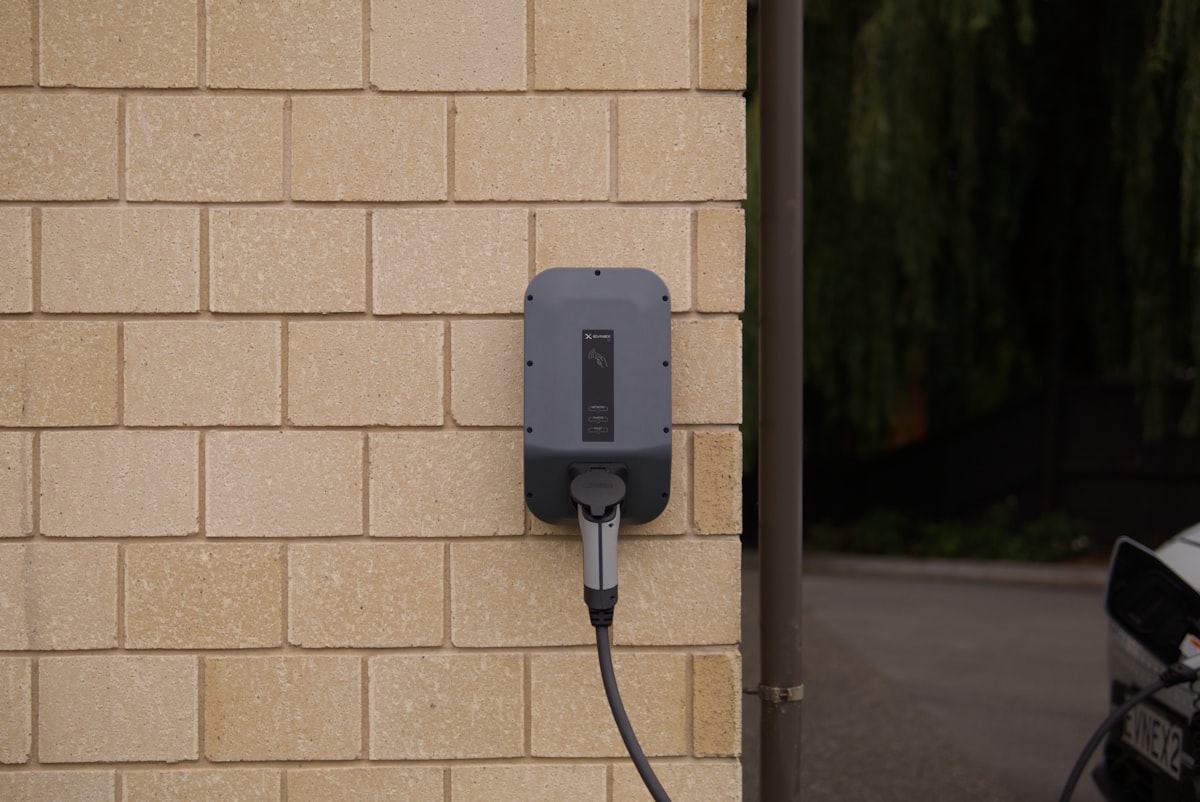
Option 2: A Dedicated 32A Wall-Box Charger (Level 2)
This is the upgrade that changes everything. A 32A dedicated wall-box charger (called a Level 2 charger) delivers up to 7.4 kW, between 5 and 8 times faster than the 13A socket. That same 40 kWh battery fills in about 6 hours instead of 14. You plug in at 11 PM, and by 5 AM you have a full car.
Installation requirements are not optional:
- A dedicated circuit run by a qualified electrician. This is not a DIY job.
- Minimum 6 mm² cable to handle continuous 32A load safely.
- A Residual Current Device (RCD) for shock protection. Mandatory.
- Surge arresters at your distribution board. Nigeria's grid surges on restoration after outages; without protection, that surge hits your charger.
About 20 to 30% of home installations also require an electrical panel upgrade if the existing board cannot support the additional load. Your electrician should assess this first.
Budget for the total job: ₦300,000 to ₦800,000 covering the wall-box hardware plus professional installation. Hardware alone (imported) runs ₦669,000 to ₦1,794,000 depending on brand and specification, so sourcing locally through a supplier in Lagos or Abuja can make a real difference. Get at least three quotes.
One caveat on three-phase power: if your compound has three-phase supply (more common in commercial areas than residential), you could theoretically charge at up to 22 kW AC. Most Nigerian homes run on single-phase, so the practical ceiling is 7.4 kW.
Option 3: Charging From Your Inverter or Solar System
This is how most serious Nigerian EV owners solve the grid reliability problem. But there is one rule that cannot be skipped: your inverter must produce pure sine wave output.
The most common home inverters in Nigeria, the cheap modified sine wave units, produce erratic AC that EV onboard chargers reject entirely. Your car will simply not charge, or worse, the charger overheats. Only pure sine wave inverters work. Hybrid solar inverters (Deye, Victron Energy, Huawei are widely available in Nigeria) all produce pure sine wave output and are the right choice.
For a daily commute of around 50 km, the EV alone needs roughly 10 kWh per day. A system sized for that requires approximately:
- 450 to 600W of solar panels (minimum for the EV's share alone)
- A 200Ah battery bank
- A 3 to 5 kVA hybrid inverter
For a whole-home-plus-EV setup, plan for a 10 to 12 kW solar array and a 10 to 15 kWh lithium battery bank.
On batteries: go LiFePO4 (lithium iron phosphate) if budget allows. LiFePO4 lasts 10 or more years, handles Nigeria's heat better than lead-acid, and can discharge to 80 to 90% of capacity. Lead-acid is limited to 50% depth of discharge and will need replacement in 3 to 5 years under daily cycling.
Hybrid inverter hardware alone runs ₦1.38 million to ₦3.24 million. A full residential LiFePO4 battery bank (10 to 15 kWh) is ₦8.8 million to ₦14.8 million. A complete system including solar, inverter, batteries, and Level 2 charger can reach ₦23 million to ₦38 million for a comprehensive 10 kW setup. Many owners start smaller and scale up. A typical mid-range residential solar-inverter system in Nigeria (not sized specifically for EV) runs ₦2 million to ₦6 million.
Charge your solar bank during peak sun hours, 10 AM to 3 PM, and use that stored power for overnight EV charging. When NEPA light does show up, a hybrid inverter seamlessly switches over and tops up both the house batteries and the car. That is the setup that makes EV ownership genuinely stress-free in Nigeria.
Charging From a Generator: Yes, But With Rules
Sometimes NEPA is gone for three days and your inverter bank is depleted. Your I-Pass-My-Neighbour generator is sitting right there. Can you use it?
Only if it is an inverter-type generator producing clean pure sine wave AC output (total harmonic distortion under 3%). Standard open-frame petrol generators, including the I-Pass-My-Neighbour and most common Nigerian standby generators, produce erratic voltage spikes that trigger EV safety lockouts and can damage the onboard charger. As one technical guide puts it plainly: dirty power causes the generator and EV charger to overheat, potentially damaging both.
If you have an inverter generator, the minimum size for Level 1 (13A) EV charging is 2,000W, though 4,500W or more is recommended for safe headroom. For Level 2 (32A) charging from a generator, you need a unit producing 6,800W or more with native 240V output.
One more thing: many portable inverter generators use a floating neutral design with no direct earth ground. Modern EVs detect this and refuse to charge, showing a Ground Fault Error, usually a flashing red light on the portable charger. The fix is a Neutral-Ground Bonding Plug, a small adapter that internally connects neutral and ground wires. Cost: approximately ₦21,000. Availability in Nigeria is limited; check online or with an auto-electrical supplier.
Generator safety rule that is non-negotiable: never run a generator in a closed garage or room while charging. The exhaust produces carbon monoxide. The generator stays outside, in open air, always.
Extension cords matter too. If you are running a cord from the generator to the car, use minimum 10 to 12 AWG gauge (roughly 4 to 6 mm²), rated for outdoor use, fully grounded. A thin household extension cord under sustained EV charging load will overheat.
Keeping Your Battery Healthy in Nigeria's Climate
Nigeria's heat is a genuine factor. High ambient temperatures can reduce EV range by up to 20% versus the manufacturer's rated figure. Park in shade wherever possible. If your EV supports pre-cooling while plugged in, use it: the cabin cools using charger power, not battery power.
For daily use, keep the battery between 20% and 80%. This is called the 20-80 rule and it reduces cell stress significantly. Only charge to 100% when you actually need maximum range. Never leave the battery sitting at 0% or 100% for extended periods.
On charging speed and battery health: DC fast chargers (50 kW and above) can bring a battery from 20% to 80% in about 40 minutes. But frequent fast charging stresses the battery more than slow overnight charging. For daily home use, slower is better for the long run.
When to Charge on the Grid
If you rely on grid power, timing matters. The optimal window is 10 PM to 6 AM, when national demand is lower and supply tends to be more stable. Many EVs let you schedule charging to start at a set time. Use that feature: plug in when you get home, set a 10 PM start, and let the car do the work.
If your building has Band A supply (20 to 24 hours per day), you are well-positioned for home charging. Band A electricity runs ₦225 to ₦229 per kWh. Band B supply (16 to 20 hours) costs approximately ₦63 per kWh, significantly cheaper, though you get fewer reliable supply hours to work with.
What Is Coming on Public Charging
As of late 2025, Nigeria had approximately 12 commercial public charging stations, concentrated in Lagos and Abuja. Qoray Mobility operates AC stations in Lagos at ₦300/kWh and DC fast charging at ₦500/kWh. Abuja has stations from Possible EVS in Wuse II, ECN in Garki, JEMAG Energy at Jabi Lake Mall, and A.Y.M Shafa at Mabushi.
Public charging will grow. But the EV owners who thrive in Nigeria right now are the ones who have sorted their home setup first. Public charging is a top-up, not a lifeline.
What These Cost on ChargeWay
You do not have to navigate the import process alone. ChargeWay sources quality tested used EVs direct from China at wholesale pricing. Every vehicle is properly inspected before it ships. Here is what you could pay right now:
| Model | FOB Price | Est. Landed Price | Range |
|---|---|---|---|
| BYD Seagull | $10,000 | ~N18,500,000 | 305 km |
| Neta V | $12,000 | ~N22,000,000 | 380 km |
| BYD Dolphin | $16,000 | ~N28,000,000 | 427 km |
These are estimated wholesale prices for quality tested vehicles, shipped direct from China. No middleman markup, no dealer premium. Final prices depend on current exchange rates at time of order. Visit chargeway.africa/cars for live pricing and available stock.
Related Articles
Can You Charge an EV with a Generator in Nigeria?
NEPA goes off at 11pm, your EV is at 18%, and your generator is already running. Here is exactly what you need to know before you plug in.
6 min read
ChargingWhere to Charge Your EV in Lagos (2025 Complete Guide)
Lagos has between 8 and 12 commercial EV charging stations, almost all run by one company. Home charging is how most owners survive. Here is exactly where to plug in, what it costs, and how to set yourself up.
7 min read
ChargingDC Fast vs AC Level 2 Charging: What Nigerian EV Owners Need
Most public chargers in Nigeria are AC. DC fast chargers exist but are rare, expensive to install, and grid-dependent. Here is how to tell them apart, which one your car can use, and what it costs.
7 min read