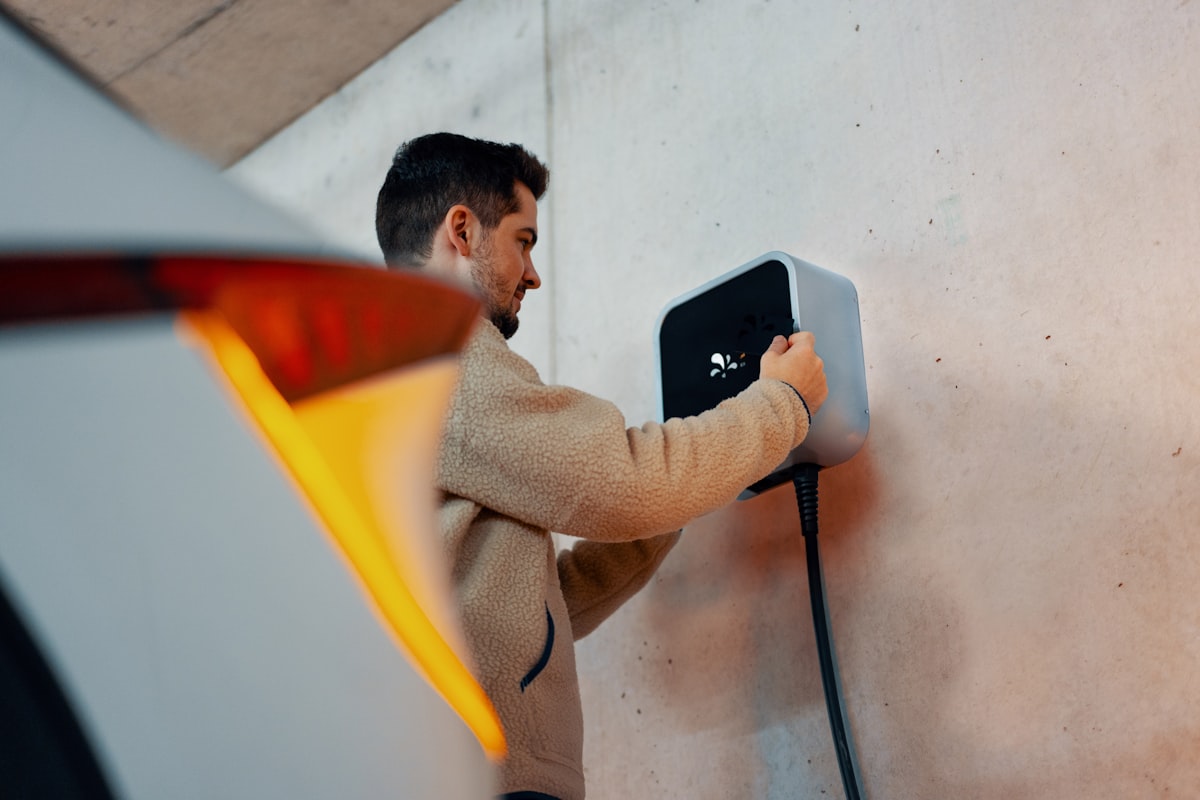
How to Install a Home EV Charger in Nigeria (Step-by-Step)
A 13A socket will charge your EV eventually. A Level 2 wall-box does it far faster. Here is how to get one installed safely in a Nigerian home, from load calculations to the right electrician.
The Problem with the 13A Socket
You drive home from the office in Ikeja, plug your new EV into the nearest wall socket, and go to bed. Eight hours later you check the app. 40% charged. You have a 7 AM meeting in Lekki.
That is what charging on a standard 13A ring-main socket feels like. At 240V and 13A, you are getting about 3 kW into the battery. For a 40 kWh battery pack, that is more than 14 hours from empty. It works in theory. In practice, it is slow enough to cause real problems.
A Level 2 wall-box charger at 7 kW (32A, single-phase) cuts that same charge to roughly 6 hours. The hardware exists. Getting it properly installed in a Nigerian home is the part that confuses most people.
What Your Home Can Actually Handle
Most Nigerian residential properties run on a single-phase 240V, 50Hz supply. Your consumer unit (the breaker box on the wall) is typically rated at either 60A or 100A. That is the ceiling for everything running in your home simultaneously.
A 7 kW (32A) EV charger adds 7,680W of sustained load to that ceiling. To put that number in context: it is roughly equivalent to running five air conditioners at the same time, for six hours straight. A typical three-bedroom flat in Lagos or Abuja already draws between 4,000W and 8,000W when the ACs are on, the pumps are running, and the fridge is cycling.
If you have a 60A consumer unit, the maths gets tight fast. A 100A consumer unit gives you 24,000W of capacity and comfortably accommodates a 32A charger on top of normal household load. This is why load calculation comes before everything else.
Step 1: Do the Load Calculation
Do not skip this step. An undersized circuit will trip your main breaker. An overloaded panel is a fire risk. The calculation takes about 20 minutes with an electrician who knows what they are doing.
The process has three parts:
- Add up your existing circuit loads. List every live MCB (Miniature Circuit Breaker) in your consumer unit, note its amperage, and convert to watts: watts = amps x 240V. A 15A breaker feeding the sitting room ACs carries 3,600W.
- Add the charger at full load, no discounts. EV chargers are treated as continuous loads, meaning they draw full current for three or more hours per session. A 32A charger adds 7,680W. A 16A charger adds 3,840W. There is no demand-factor reduction allowed for EV chargers.
- Compare to 80% of your main breaker rating. The safe continuous threshold for your main breaker is 80% of its rating. A 60A panel should not sustain more than 11,520W (60A x 240V x 0.80). A 100A panel handles up to 19,200W continuously.
If your existing load plus the charger load exceeds that 80% threshold, you have a decision to make before any charger goes on that wall.
Step 2: Decide on Charger Size
Most Nigerian homes have a choice between two practical options:
| Option | Power | Time to charge 40 kWh battery | Circuit requirement | Hardware cost (estimate) |
|---|---|---|---|---|
| Portable EVSE cable (Level 1/2) | 3.5 kW / 16A | ~12 hours | 20A dedicated MCB, 4 mm² cable | N75,000 to N150,000 |
| Level 2 wall-box | 7 kW / 32A | ~6 hours | 40A dedicated MCB, 6 mm² cable | N150,000 to N350,000 |
If your consumer unit is 60A and your load calculation leaves no room for 32A, start with the 16A option. It still charges considerably faster than a 13A socket, and it will not push your panel past its limit. Upgrade the panel later when you are ready to spend N60,000 to N130,000 on the job.
Note: Nigeria's residential areas are almost entirely single-phase. Three-phase 11 kW or 22 kW chargers exist, but they require a three-phase service entrance that most Lagos and Abuja residential compounds simply do not have. Single-phase 32A is your practical upper limit at home.
Step 3: Understand What the Electrician Must Install
A proper Level 2 installation is not a plug-and-play job. Three things must happen, and each one matters.
A dedicated circuit, not a shared one
The charger needs its own MCB slot in your consumer unit, its own cable run directly to the charger location, and nothing else sharing that circuit. A 32A charger requires 6 mm² cable minimum. A 16A charger requires 4 mm² cable minimum. For runs longer than 10 metres, go up one cable size to compensate for voltage drop.
In 2025 Nigerian prices, 4 mm² twin-and-earth cable costs N900 to N1,300 per metre. The 6 mm² size runs N1,500 to N2,500 per metre. A 10-metre cable run for a 32A charger costs N15,000 to N25,000 in cable alone before any labour.
The charger must also never be connected through an extension cable or multi-socket adapter. Standard extension leads are not rated for continuous 32A load. This is a known fire hazard, not a theoretical one.
A dedicated MCB sized at 125%
Because EV chargers are continuous loads, the circuit breaker protecting the dedicated circuit must be rated at 125% of the charger's operating current. For a 32A charger: 32A x 1.25 = 40A MCB. For a 16A charger: 16A x 1.25 = 20A MCB. This is the minimum. Do not let anyone cut corners here.
A Type B RCD
A Residual Current Device (called an ELCB or RCCB in Nigerian trade) cuts the power the moment it detects dangerous earth-fault leakage current, as small as 30 milliamps, in milliseconds. It is the thing standing between your family and electrocution if there is ever a fault in the system.
For EV chargers specifically, you need a Type B RCD, not the cheaper Type A. EV chargers can produce DC residual currents that a Type A RCD (which only detects AC faults) will completely miss. Type B RCDs cost N15,000 to N45,000 in Nigeria. Outside Lagos and Abuja, sourcing Type B can be difficult, so factor in lead time if you are in Port Harcourt or elsewhere.
Step 4: Upgrade the Panel If Needed
If your load calculation shows insufficient headroom, you have three options:
- Upgrade the consumer unit from 60A to 100A. This is the clean solution. Materials (the distribution board itself) cost N25,000 to N60,000. Labour for a licensed electrician adds N20,000 to N50,000. Total: N60,000 to N130,000.
- Install a smart load manager. An energy management device monitors your total home load and throttles the charger when other heavy appliances are running. Hardware adds N30,000 to N80,000 but you avoid the panel replacement entirely.
- Use a 16A charger instead of 32A. If your 60A panel can accommodate the smaller charger load, this is the cheapest path to reliable overnight charging with no panel work at all.
What It Actually Costs
These are the realistic numbers for installation in Lagos or Abuja in 2025. Hardware (the charger unit itself) is separate.
| Scenario | What is included | Cost estimate (installation only) |
|---|---|---|
| Entry-level: 16A charger, existing 100A panel | Dedicated 16A circuit + Type B RCD + MCB + conduit + labour (5-10m run) | N50,000 to N80,000 |
| Standard: 32A charger, existing 100A panel | Dedicated 32A circuit + Type B RCD + MCB + conduit + labour (5-10m run) | N70,000 to N125,000 |
| Comprehensive: 32A charger, panel upgrade from 60A to 100A | Everything above plus distribution board replacement | N120,000 to N200,000 |
A NEMSA-certified electrician charges N10,000 to N20,000 per day in Lagos. A proper Level 2 installation typically takes one to two days of skilled labour. Get three quotes and ask each contractor specifically for their NEMSA certification number before anyone starts work.
Who to Hire (and Who Not To)
The EV charger installation market in Nigeria has no shortage of informal electricians willing to do the job for N5,000 to N15,000. That price point should make you nervous. Abeg, do not be tempted.
NEMSA (Nigerian Electricity Management Services Agency) is the sole agency authorised by law to certify electrical installations and personnel in Nigeria. Only NEMSA-certified contractors may legally carry out and certify this kind of work. They maintain a directory at nemsa.gov.ng.
For a standard residential installation, a NEMSA-certified electrician is sufficient. If you are doing a full consumer unit upgrade or any modifications to your building's service entrance, you may need a COREN-registered electrical engineer overseeing the job. COREN registration requires at minimum four years of post-qualification experience plus passing a formal engineering practice examination.
The cost difference between an informal handyman (N5,000 to N15,000) and a NEMSA-certified electrician (N20,000 to N60,000 for the labour portion) is small relative to the risk. Incorrect circuit sizing causes cable overheating and fires. A missing earth connection is an electrocution risk, especially in Nigeria's wet outdoor compounds. Most EV charger manufacturers also require certified installation to honour the warranty. If there is ever a claim, you will need to prove the work was done properly.
The Running Cost After Installation
Once the charger is on the wall, the electricity cost is your main ongoing number to know. Nigeria's Band A tariff sits at approximately N225/kWh as of early 2025. Filling a 40 kWh battery from empty costs about N9,000 at that rate.
For a 200 km weekly commute consuming roughly 25 kWh, your weekly electricity bill is approximately N5,600. The same distance in a petrol car costs N40,000 to N60,000 in fuel. The savings are not subtle.
If your neighbourhood is Band B, C, or D (fewer supply hours per day), home charging still works but you may lean harder on a solar-inverter to keep the car topped up through NEPA outages. That changes the circuit design slightly, so raise it with whoever is quoting your installation.
What Is Coming Next
As of 2025, Nigeria has approximately 12 public EV charging and battery-swapping sites nationwide. That number is small, which is exactly why home charging matters so much right now. The practical reality for most EV owners is that home charging carries 80 to 90% of the load.
The FG has signalled further electricity tariff adjustments for 2025 as part of broader power sector investment. NEMSA published an updated electrician certification scheme in 2024. EV imports are growing fast under the used EV model. Each of those trends points in the same direction: demand for home charger installations will increase significantly through 2026. Getting yours done properly now, by a NEMSA-certified contractor, means you are ahead of the queue when the market matures and installers get busy.
What These Cost on ChargeWay
You do not have to navigate the import process alone. ChargeWay sources quality tested used EVs direct from China at wholesale pricing. Every vehicle is properly inspected before it ships. Here is what you could pay right now:
| Model | FOB Price | Est. Landed Price | Range |
|---|---|---|---|
| BYD Seagull | $10,000 | ~N18,500,000 | 305 km |
| Neta V | $12,000 | ~N22,000,000 | 380 km |
| BYD Dolphin | $16,000 | ~N28,000,000 | 427 km |
These are estimated wholesale prices for quality tested vehicles, shipped direct from China. No middleman markup, no dealer premium. Final prices depend on current exchange rates at time of order. Visit chargeway.africa/cars for live pricing and available stock.
Related Articles
Can You Charge an EV with a Generator in Nigeria?
NEPA goes off at 11pm, your EV is at 18%, and your generator is already running. Here is exactly what you need to know before you plug in.
6 min read
ChargingHow to Charge Your EV at Home in Nigeria
Most Nigerian EV owners never see the inside of a public charging station. They plug in at home every night. Here is exactly how to do it safely, what it costs, and what to do when NEPA is not cooperating.
8 min read
ChargingWhere to Charge Your EV in Lagos (2025 Complete Guide)
Lagos has between 8 and 12 commercial EV charging stations, almost all run by one company. Home charging is how most owners survive. Here is exactly where to plug in, what it costs, and how to set yourself up.
7 min read