What to Do When Your EV Runs Out of Charge in Nigeria
Nigeria has fewer than 20 public charging sites nationwide. If your battery dies on the road, the next 5 minutes matter. Here is exactly what to do, what not to do, and how to avoid it again.
The Moment the Turtle Appears
You are on the Third Mainland Bridge, 7 PM, traffic crawling. The dashboard flashes a small turtle icon and your speed caps at 25 km/h. You had 18% battery when you left the office. The AC was running the whole time. Now you have about 8 km of range left and the nearest charging station is in Victoria Island.
With fewer than 20 public EV charging sites across the entire country, Nigeria gives drivers very little margin for error. When it happens to you, the difference between a manageable inconvenience and a very expensive repair comes down to what you do in the next few minutes.
What Is Actually Available Right Now
Be honest with yourself about the landscape. Nigeria's public charging network is real but thin. Almost all the stations sit inside Lagos and Abuja. Most highways between cities have zero public charging infrastructure, which means inter-city driving without a plan is a genuine gamble.
About 80% of Nigerian EV drivers charge at home or at work, handling daily city commutes of 30 to 80 km without ever needing a public station. That works because most EVs sold here deliver 280 to 420 km per full charge. Running out during a normal urban day means something went wrong with the plan, not the car.
Range anxiety is a real, documented issue for inter-city trips. For daily city driving, it rarely applies. Knowing which problem you actually have changes how you respond.
Your First 5 Minutes
When the low-battery warnings start, most EVs give you three alerts: at 20%, at 10%, and at 5% remaining. That is your window to act before turtle mode kicks in and limits your speed to 20 to 30 km/h.
- Switch on hazard lights immediately. Even at 30% battery, do this as a precaution if you are in heavy traffic.
- Move to the nearest safe stopping point. A petrol station forecourt, a car park entrance, or a paved shoulder. Avoid stopping in a live lane.
- Turn off the AC. Heavy AC use in Lagos heat can cut your effective range by 15 to 25%. Every kilometer counts right now.
- Open PlugShare on your phone. It maps real-time station availability across Nigeria with user check-ins confirming whether each station is actually working. Find the closest live station and calculate whether you can reach it.
Charging Stations to Know in Lagos and Abuja
If you are in Lagos, these are the stations most likely to help in an emergency. Always verify on PlugShare before driving to any of them, because stations do go offline.
- Sheraton Lagos Hotel, Ikeja: 60 kW DC fast charger, operates 24/7
- Lagos Marriott Hotel, Ikeja: 60 kW DC fast charger
- Mega Plaza Car Park, Victoria Island: SAGLEV station
- The Palms Lekki: SAGLEV station
- Marina Road: Qoray station
In Abuja, the Energy Commission of Nigeria HQ in Garki runs a solar-hybrid station capable of a full charge in 30 minutes. There are also sites in Wuse. DC fast charging costs approximately N500 per kWh across Nigeria, so a 60 kWh top-up runs about N30,000. Standard AC public charging is closer to N300 per kWh.
If You Cannot Reach a Station: Mobile Charging
Mobile emergency EV charging is an emerging service in Nigeria. Bee Charged EV claims 24/7 dispatch with certified technicians and portable charging equipment to Lagos, Abuja, Port Harcourt, Ibadan, and Kano, with an average arrival time of 30 minutes in metro areas. Their website is beechargedev.com.
A fair warning: the company's registered address is in the United States and the number listed is a US +1-888 line. Before you rely on them as your primary emergency contact, call ahead and confirm they have Nigeria-based dispatch operating in your city. Treat this as a promising service still establishing itself, not a guaranteed network.
Possible EVS has also announced plans to deploy solar-powered mobile dispensers across Lagos and Abuja for on-demand emergency top-ups. That initiative is rolling out rather than fully deployed.
For a safer fallback, Travo.ng offers 24/7 nationwide towing and breakdown services via their website and WhatsApp, covering Lagos, Abuja, Port Harcourt, and major highway routes including the Lagos-Ibadan Expressway, Abuja-Lokoja Highway, and Port Harcourt-Owerri Road. If you use them, the section below on towing safety is critical reading.
When nothing else works, call FRSC on 122. It is free, 24/7, and works on all networks. The Federal Road Safety Corps cannot charge your battery, but they can assist with traffic management, flag down help, and coordinate with local authorities. Most Nigerian drivers do not know this number exists. Save it now.
The Most Expensive Mistake: Wrong Towing
This is the part that most Nigerian drivers get wrong. It can destroy a car that was perfectly fine except for a flat battery.
Never let a regular tow truck drag your EV with the driven wheels on the ground. Electric motors are mechanically linked to the wheels and act as generators when those wheels spin. Towing with the drive wheels rotating generates electrical current that can overheat the motor windings, damage the inverter, and stress the battery management system. Repairing an inverter or battery management computer costs between N8 million and N24 million, the equivalent of $5,000 to $15,000 at current rates.
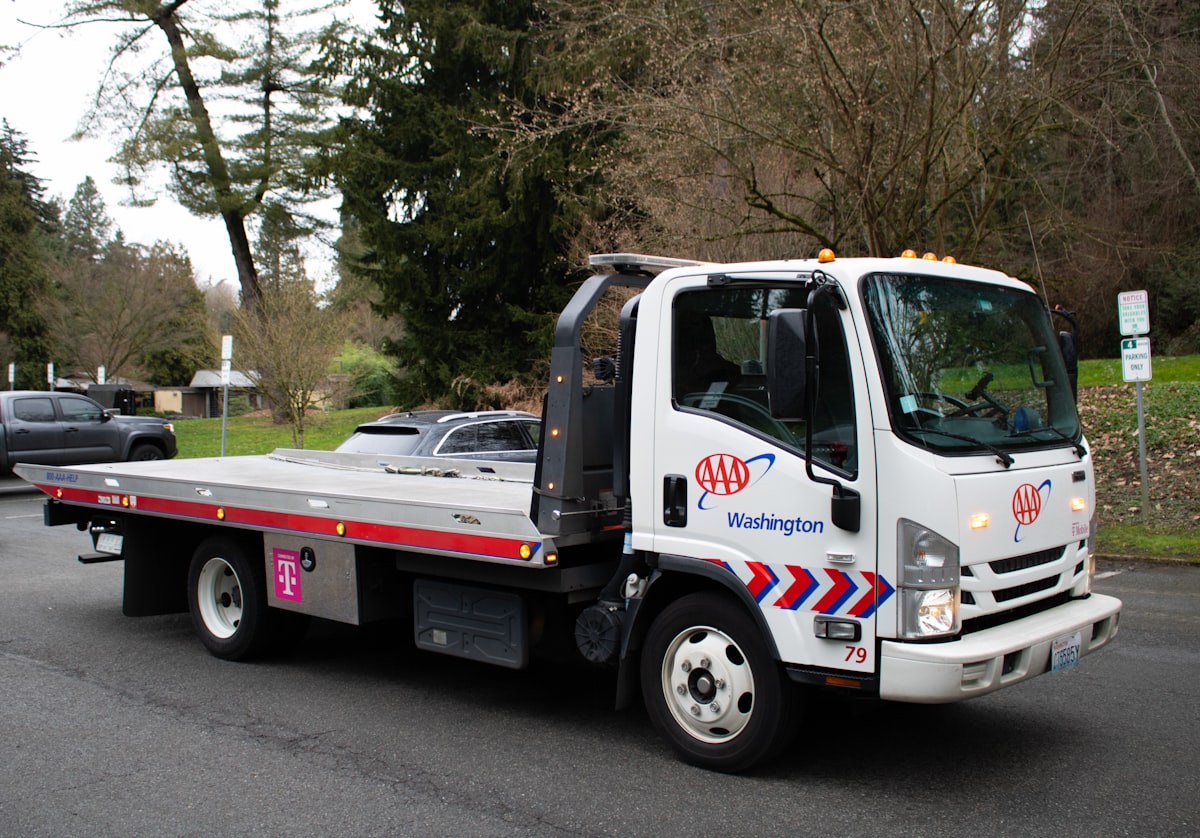
The rule is simple: flatbed only, all four wheels off the ground. Wheel-lift towing, where one axle is raised while the other rolls, is still dangerous for most EVs. Dolly towing, which lets the rear wheels rotate, is particularly risky. Towing an EV above 13 to 16 km/h with drive wheels spinning can damage the high-voltage system even at low speed.
Tesla, BMW, Audi, and Mercedes all explicitly state that improper towing can void powertrain warranties. When you call any towing service, say these exact words: "This is an electric vehicle. Send a flatbed only." Check your owner's manual to confirm your specific car's requirements before the tow begins.
Practical Tips to Avoid This Entirely
The drivers who never end up stranded follow a consistent set of habits.
- Use the 30-80% rule for daily driving. Keep the battery between 30% and 80% during normal use to preserve long-term battery health. Charge to 100% only before a long trip.
- Plan inter-city routes around charging stops. Before any trip outside your city, open PlugShare and identify charging points at your origin, your destination, and at least one midway stop. There are no charging stations on most Nigerian highways. This is not optional planning; it is essential.
- Manage the AC. In Lagos traffic with the sun overhead, your AC can reduce effective range by 15 to 25%. On low-battery days, lower the cabin temperature before you leave rather than blasting cold air on the road.
- Park in shade. Passive battery drain from heat is real in Nigeria's climate. A shaded spot is not just comfort; it protects your range.
- Check PlugShare before every unfamiliar route. Station status changes. A location that worked last month may be offline today. The check-in feature shows which stations other drivers have recently confirmed as working.
The Honest Picture on What Is Coming
Nigeria's charging network is thin today, but it is not static. Possible EVS's solar-powered mobile dispensers are designed specifically for a grid-unreliable environment like Nigeria's, which makes them a more sustainable model than stations dependent on NEPA. SAGLEV and Qoray continue adding sites in Lagos. The Energy Commission station in Abuja shows that solar-hybrid public charging can work here.
Meaningful highway charging infrastructure is still years away. For now, city driving is manageable, inter-city driving requires planning, and every EV owner in Nigeria should have the FRSC number and PlugShare installed before they need them. Those two things cost nothing.
What These Cost on ChargeWay
You do not have to navigate the import process alone. ChargeWay sources quality tested used EVs direct from China at wholesale pricing. Every vehicle is properly inspected before it ships. Here is what you could pay right now:
| Model | FOB Price | Est. Landed Price | Range |
|---|---|---|---|
| BYD Seagull | $10,000 | ~N18,500,000 | 305 km |
| Neta V | $12,000 | ~N22,000,000 | 380 km |
| BYD Dolphin | $16,000 | ~N28,000,000 | 427 km |
These are estimated wholesale prices for quality tested vehicles, shipped direct from China. No middleman markup, no dealer premium. Final prices depend on current exchange rates at time of order. Visit chargeway.africa/cars for live pricing and available stock.
Related Articles
Can You Charge an EV with a Generator in Nigeria?
NEPA goes off at 11pm, your EV is at 18%, and your generator is already running. Here is exactly what you need to know before you plug in.
6 min read
ChargingHow to Charge Your EV at Home in Nigeria
Most Nigerian EV owners never see the inside of a public charging station. They plug in at home every night. Here is exactly how to do it safely, what it costs, and what to do when NEPA is not cooperating.
8 min read
ChargingWhere to Charge Your EV in Lagos (2025 Complete Guide)
Lagos has between 8 and 12 commercial EV charging stations, almost all run by one company. Home charging is how most owners survive. Here is exactly where to plug in, what it costs, and how to set yourself up.
7 min read