DC Fast vs AC Level 2 Charging: What Nigerian EV Owners Need
Most public chargers in Nigeria are AC. DC fast chargers exist but are rare, expensive to install, and grid-dependent. Here is how to tell them apart, which one your car can use, and what it costs.
The man standing at Adeola Odeku
Picture a BYD Atto 3 owner pulling into the Qoray Mobility station on Adeola Odeku, Victoria Island. Two cables hang from the charger unit. One is a neat wall-mounted connector. The other is a thick cable attached to a box the size of a small fridge, bolted to the floor. He grabs the wall one. Forty-five minutes later his car has barely moved. He should have grabbed the other cable. The difference between those two choices is the difference between AC and DC charging, and in Nigeria right now, that difference matters more than anywhere else.
What actually happens inside the charger
Your EV battery stores electricity as DC (direct current). But the Nigerian grid, like every grid in the world, delivers power as AC (alternating current). Something has to convert one to the other before electrons can go into the battery.
With AC Level 2 charging, that conversion happens inside your car. A component called the onboard charger (OBC) does the work. The station just delivers AC power and your car converts it. The problem is that most OBCs max out at 7.4 kW or 11 kW. Even if you plug into a 22 kW station, the car will only accept as much as its OBC can handle. At 7.4 kW, a 40-60 kWh battery takes 4-8 hours to charge from empty.
With DC fast charging, the conversion happens inside the charging station itself. The station sends DC power directly to the battery, bypassing the OBC entirely. That is why DC chargers can deliver 50-350 kW. At 60 kW (the typical rating at Nigerian public stations), a 60 kWh battery goes from 10% to 80% in 20-45 minutes.
What Nigeria actually has right now
As of late 2025, Nigeria had just 12 public EV charging and battery-swapping sites nationwide, with fewer than 500 registered EVs on the road. Those two numbers sit next to each other for a reason: there is no business case yet for dense DC fast-charging networks.
Qoray Mobility operates the country's primary charging network, running both types. Their AC chargers deliver 22 kW through Type 2 or Type 1 connectors at N300 per kWh. Their DC fast chargers deliver 60 kW through CCS2 or GB/T connectors at N500 per kWh. That gap is significant. A full charge on a 42 kWh battery at home on DISCO Band A tariff costs approximately N9,450 at N225 per kWh. The same charge at Qoray's DC fast charger costs N21,000.
DC fast chargers in Nigeria are rare for clear reasons. Hardware and installation costs run $50,000-$200,000 per site, versus a few hundred to $10,000 for an AC Level 2 setup. They also require three-phase 415V power at high amperage. That is a serious ask of a grid that generates 4,000-4,500 MW against a national demand of 30,000 MW, loses 40-45% of power in transmission, and collapsed six times in 2023 alone. Sub-Saharan Africa averages 39.30 hours of power outage per year. OECD countries average 0.87 hours. NEPA light has always been a topic in this country; for DC fast charging, it is an infrastructure barrier.
Where to charge in Lagos and Abuja today
Lagos
Qoray Mobility has the most complete network, with both AC and DC at these locations:
- 20 Marina Road, Lagos Island (AC + DC)
- Adeola Odeku, Victoria Island (AC + DC)
- Sheraton Hotel, Ikeja (AC + DC)
- Marriott Hotel, Ikeja (AC + DC)
- Ikoyi (AC)
- Ilupeju (AC)
Olabanjo Alimi, CEO of Qoray Mobility, put the strategy plainly: "By installing both AC and DC fast chargers in a secure, high-traffic location like the Sheraton Lagos Hotel, we are building the confidence needed for a widespread shift to electric vehicles."
SAGLEV operates AC-only stations at Mega Plaza Car Park rooftop, Victoria Island and The Palms, Lekki. Pricing at SAGLEV stations is not publicly confirmed, so budget using Qoray's N300/kWh AC rate as a reference.
Abuja
The Energy Commission of Nigeria (ECN) operates a hybrid solar/grid station in Garki, Abuja that is reported to fully charge an EV in approximately 30 minutes, though whether it is AC or DC is not confirmed in available sources. Jabi Lake Mall also has a charging facility. If you are driving north from Lagos, confirm availability before you leave. Do not assume.
Your connector: the question that causes the most wahala
Knowing where to charge is only half the problem. Knowing whether your cable will fit is the other half.
Type 2 (Mennekes)
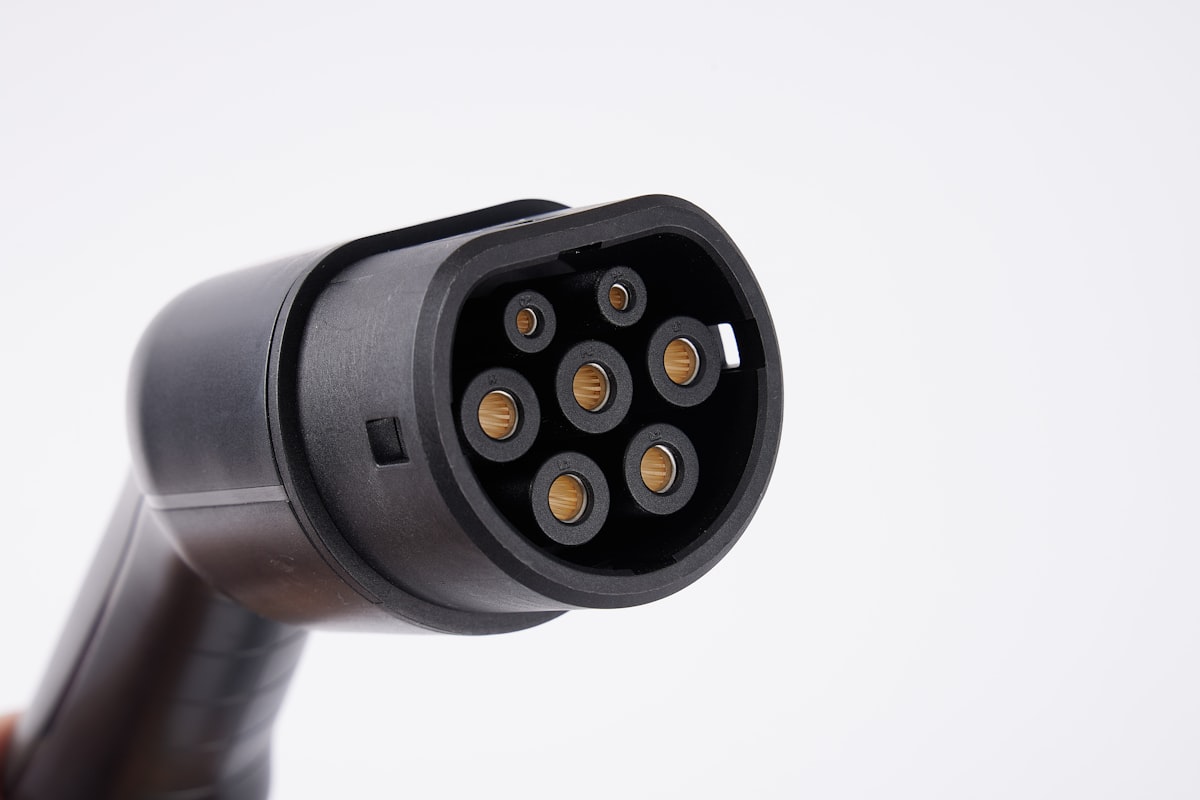
This is the dominant AC charging connector at Nigerian public stations. It has seven pins and handles both single-phase (up to 7.4 kW) and three-phase (up to 22 kW) through the same plug. If you bought a European-spec EV or a BYD officially sold through CFAO/LOXEA Nigeria (which entered in March 2025), your AC port is almost certainly Type 2.
CCS2 (Combined Charging System Type 2)
CCS2 is the DC fast-charging standard taking hold across Africa, including Nigeria. It looks like a Type 2 plug with two additional high-power DC pins added below. A CCS2 vehicle can use one inlet for both AC and DC charging. Qoray's 60 kW DC chargers support CCS2. If your car is an international-market BYD or another European-standard EV, CCS2 is likely your DC connector.
GB/T
GB/T is China's national EV charging standard, used by all Chinese EVs sold on the domestic Chinese market. BYD, NIO, Xpeng, MG, Geely, SAIC, and Jaecoo vehicles built for China have two separate ports: one for GB/T AC and one for GB/T DC. These are physically incompatible with Type 2 and CCS2 without an adapter.
Qoray's DC chargers in Nigeria support GB/T alongside CCS2, which helps. But if you privately imported a used Chinese-market BYD, confirm which port it has before you need it urgently. International-market BYD models typically ship with CCS2; China-spec imports carry GB/T. Open the charging flap and count the pins before you are sitting at 8% on Third Mainland Bridge.
CHAdeMO
You may see this standard in older EV content. CHAdeMO is a Japanese DC fast-charging protocol being phased out globally. It is not available at any confirmed Nigerian public charging station. If your EV has only a CHAdeMO DC port, public fast-charging options in Nigeria are currently very limited.
How to identify charger type at a Nigerian station
When you arrive at a charging station, here is how to read what you are looking at:
- AC Level 2: Wall-mounted or pedestal unit, single cable with a 7-pin Type 2 receptacle, power rating of 7-22 kW. Compact, roughly the size of a household distribution board.
- DC fast charger: Large floor-standing unit, heavy cable, power rating of 50 kW or more. Multi-standard units have multiple cables, typically Type 2 AC plus CCS2 DC plus GB/T DC hanging from the same column.
The cable weight is the fastest cue. If it feels like something from a petrol pump, you are at a DC charger. If it feels like a kettle lead, you are at AC.
What DC fast charging does to your battery
DC fast charging is harder on your battery than AC. Over 50,000 miles of predominant DC fast charging, research shows 3-9% additional battery capacity loss compared to predominantly AC charging. Battery manufacturers recommend using DC fast charging for long trips and urgent top-ups, not as a daily habit.
At Nigerian public station prices, your wallet will send the same message. Daily DC fast charging costs more than twice as much per kWh as charging at home.
Cost comparison: all three options side by side
| Charging method | Power | Cost per kWh | Time for 80% on a 60 kWh battery |
|---|---|---|---|
| Home (DISCO Band A) | 7.4-11 kW (OBC limited) | N225 | 4-6 hours |
| Qoray AC public (Type 2, 22 kW max) | Up to 22 kW (OBC limits apply) | N300 | 3-5 hours |
| Qoray DC fast (CCS2/GB/T, 60 kW) | 60 kW | N500 | 20-45 minutes |
Home charging is the cheapest option by a wide margin. AC public charging is a solid away-from-home option. DC fast charging is your rescue option on a long day, not your daily routine.
What is coming
The infrastructure picture will shift. In January 2026, LUG West Africa announced plans to install over 250 EV charging points across Lagos using monocrystalline solar panels integrated into existing solar street lighting. That approach directly addresses the grid reliability problem that keeps DC fast chargers rare. MAX launched West Africa's first solar-powered EV battery swap station in 2025, adding a third model alongside plug-in AC and DC charging.
Nigeria's fast-charger market is forecast to grow at 30.2% annually through 2030. The Standards Organisation of Nigeria (SON) and EMPAN ran a national standardisation webinar in July 2025, with CCS2 and Type 2 emerging as the de facto choices. No mandatory standard has been finalised as of 2026, but the direction is clear. Still, 12 public sites is 12 public sites. Plan for what exists, not what is forecast.
What These Cost on ChargeWay
You do not have to navigate the import process alone. ChargeWay sources quality tested used EVs direct from China at wholesale pricing. Every vehicle is properly inspected before it ships. Here is what you could pay right now:
| Model | FOB Price | Est. Landed Price | Range |
|---|---|---|---|
| BYD Seagull | $10,000 | ~N18,500,000 | 305 km |
| Neta V | $12,000 | ~N22,000,000 | 380 km |
| BYD Dolphin | $16,000 | ~N28,000,000 | 427 km |
These are estimated wholesale prices for quality tested vehicles, shipped direct from China. No middleman markup, no dealer premium. Final prices depend on current exchange rates at time of order. Visit chargeway.africa/cars for live pricing and available stock.
Related Articles
Can You Charge an EV with a Generator in Nigeria?
NEPA goes off at 11pm, your EV is at 18%, and your generator is already running. Here is exactly what you need to know before you plug in.
6 min read
ChargingHow to Charge Your EV at Home in Nigeria
Most Nigerian EV owners never see the inside of a public charging station. They plug in at home every night. Here is exactly how to do it safely, what it costs, and what to do when NEPA is not cooperating.
8 min read
ChargingWhere to Charge Your EV in Lagos (2025 Complete Guide)
Lagos has between 8 and 12 commercial EV charging stations, almost all run by one company. Home charging is how most owners survive. Here is exactly where to plug in, what it costs, and how to set yourself up.
7 min read