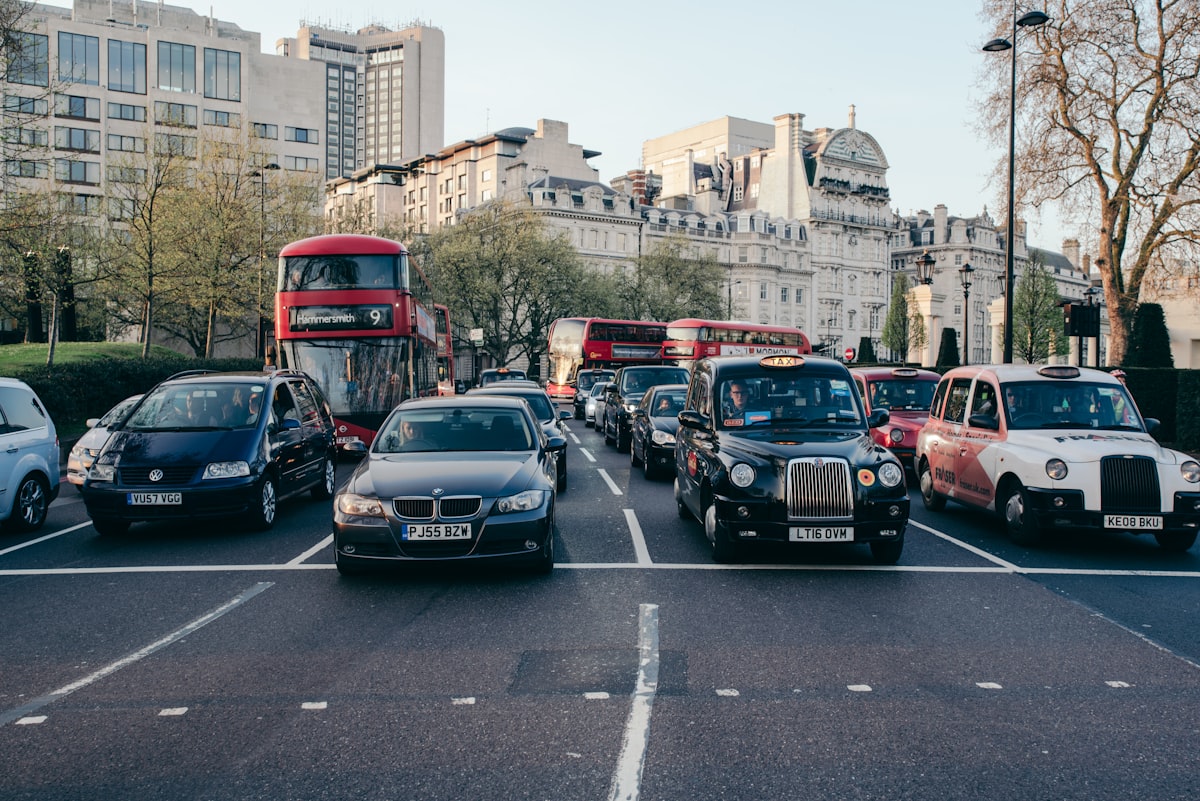
Importing a Used EV from the UK to Nigeria: The Complete Guide
UK used EVs dropped 36% in price since 2023. But before you send a deposit: UK cars have the steering wheel on the wrong side for Nigerian roads. Here is everything you need to know.
The Transfer That Almost Went Wrong
A Lagos buyer spots a 2021 Tesla Model 3 on a UK dealer site for £19,000. The exchange rate math looks good. Low mileage. Professional seller. He transfers a deposit. Three weeks later, he is on the phone with a clearing agent at Tin Can Island who asks one question that stops everything: "Is this car left-hand drive or right-hand drive?"
Right-hand drive. A UK car. And Nigeria drives on the right side of the road, which means every vehicle on Nigerian roads is left-hand drive. The steering wheel sits on the wrong side for every roundabout, every tollgate, every pothole-dodge on the Lekki-Epe Expressway. That car is, in practical terms, illegal to drive.
This guide exists so that does not happen to you.
What This Guide Covers
UK used EV prices dropped 36% between May 2023 and April 2025. A 2021-2022 Tesla Model 3 that was £31,000 at peak now trades for as little as £18,000. That opportunity is real. So are the risks: steering configuration, battery health for tropical heat, SONCAP certification, and a customs process that got stricter with the Nigeria Customs Service Act 2023.
This guide walks through every step, from finding the right car in the UK to driving it out of Tin Can Island. It is written for serious buyers doing this themselves or supervising an agent. If you want a tokunbo EV without the complexity, ChargeWay lists vetted vehicles that are already cleared and locally available.
The Most Important Thing: Steering Configuration
Nigeria switched to right-hand traffic on April 2, 1972, under Head of State Major-General Yakubu Gowon. Every neighbouring country at the time (Republic of Benin, Cameroon, Niger, Chad) was a former French colony operating on the right. Cross-border trade was a logistical nightmare. Nigeria moved, and has never moved back.
That means every car on Nigerian roads must be left-hand drive (LHD). UK cars, without exception, are right-hand drive (RHD). Driving an RHD vehicle in Nigeria is illegal. Beyond the legal issue, every highway in Nigeria is designed with LHD cars in mind. You cannot see oncoming traffic when overtaking. You cannot see the tollgate attendant properly. Every overtake becomes a guess.
The obvious question is whether you can convert the steering. Technically yes. Practically, no. RHD-to-LHD steering conversion costs £6,000 to £8,000 or more in parts and labour. That is before accounting for what the conversion disrupts: airbag systems, braking geometry, steering rack integrity, wiring, and air conditioning routing all touch the steering column. Most expert sources call it "not worth it due to high costs, risks of compromising safety features like airbags, potential steering failures, and reduced component strength." Your resale value drops to near zero. You end up with a car with compromised safety systems in a market with limited specialist EV mechanics.
So Where Do the LHD EVs Come From?
The UK does have LHD vehicles. They arrive as European imports, diplomatic vehicles, and grey-market purchases. UK platforms like AutoTrader have a LHD filter. This is a narrower pool than the full UK used EV market, and pricing on some models runs slightly higher. The search takes more patience. It is worth the effort.
Alternatively, source directly from LHD markets: Belgium, Germany, the Netherlands, and France all have large, well-organised used EV markets where every car is already LHD. This guide focuses on the UK process because the research was UK-specific, but those European alternatives deserve serious consideration.
Step-by-Step: The UK Side
Step 1. Find a LHD Vehicle and Run a Battery Health Check
Start every search with the LHD filter. Once you have a shortlist, request a State of Health (SoH) report before going any further. SoH above 90% is excellent. Between 85% and 90% is good and typical for a well-maintained 2-4 year old EV. Between 80% and 85% is acceptable but warrants careful inspection. Below 80%, walk away.
Do not use mileage as your primary filter. Two EVs with identical mileage can have completely different battery health depending on charging history. A car with 40,000 miles that was regularly charged to 100% on rapid DC chargers will typically have degraded more than the same-mileage car charged to 80% overnight on a slow home charger. The SoH number is the only honest verdict.
Also note: UK battery warranty terms are almost certainly not transferable to Nigeria. You are buying the battery as-is. Get the SoH in writing.
Step 2. Run a Full Vehicle History Check
For UK vehicles, this means MOT history (available free on the DVLA website using the registration number) and an HPI check for outstanding finance, write-off status, and stolen vehicle records. A car with outstanding finance cannot be legally transferred to you. A written-off car may have structural damage that no amount of cleaning will fix. Both checks cost under £30 combined and save you from catastrophic mistakes.
Step 3. Handle the V5C (UK Logbook)
The V5C is the UK equivalent of a vehicle title. You need the original. When the car is ready to ship, the permanent export section of the V5C must be filled in and sent to DVLA, Swansea, SA99 1BD. This is a mandatory step for UK customs compliance.
Step 4. Arrange SONCAP Certification
This is where many private importers hit a wall. All vehicle imports to Nigeria require SONCAP certification: a Product Certificate (PC) and a Shipment Certificate (SC). The PC is typically arranged by the exporter through an SON-approved inspection body such as SGS, Bureau Veritas, or Cotecna before shipment. The cost ranges from $1,000 to $3,000 for the PC and $500 to $2,000 for the SC per shipment.
If you are a private buyer, contact an SON-approved UK inspection body directly to ask how to handle this for a single-unit import. Do not skip this step. Customs will not release the vehicle without it.
Step 5. Book Shipping
RoRo (Roll-on/Roll-off) is the standard method: the car drives onto the vessel and drives off at destination. It is cheaper than container shipping and the most common method for vehicle exports. UK shipping ports serving Nigeria include Tilbury, Southampton, Sheerness, and Liverpool. The destination is Tin Can Island, Lagos (primary) or Apapa, Lagos.
RoRo from Tilbury to Tin Can Island runs £480 to £915 port-to-port. Container shipping (20-foot container, one car, which also allows you to include personal effects) costs £1,280 to £3,500. Transit time port-to-port is approximately 14 to 16 days, though the full process from shipping to driving out of port is typically 6 to 8 weeks when you include paperwork and port procedures.
Get a Bill of Lading from your shipping company. This is a mandatory document for Nigerian customs. Also arrange marine insurance for the voyage.
Step-by-Step: The Nigeria Side
Step 6. Open Form M Before the Car Ships
Form M is a Central Bank of Nigeria document that every importer must complete electronically through the Nigeria Single Window Trade Portal (trade.gov.ng) via their authorised dealer bank before the shipment departs. Its validity is 180 days. This is not a formality you do after the car arrives.
One important rule from a CBN directive dated February 26, 2024: the exchange rate used for duty assessment is locked at the rate on the day you open your Form M. With naira volatility, timing this matters. If the naira weakens between your Form M opening and your duty payment, your duty bill goes up. Check the current CBN rate, factor in some buffer, and plan accordingly.
Step 7. Gather Your Documentation Package
The Nigeria Customs Service will want: the commercial invoice, bill of lading, certificate of origin, SONCAP Product Certificate, insurance certificate, and your Form M reference. Have all of these before the vessel docks. Missing a single document causes delays, and delays at Tin Can Island cost money. Port storage fees start at N3,000 to N5,000 per day after the first 7 days.
Step 8. Obtain PAAR and Pay Duties
After Form M is validated by your bank and forwarded to Nigeria Customs, you apply for a Pre-Arrival Assessment Report (PAAR). The PAAR is issued by the Nigeria Customs Service and determines your duty amount. You cannot proceed with clearing without it.
The Nigeria Customs Service now uses a VIN-based Fair Market Value system. Duties are assessed against NCS's own database valuation for your year, make, and model. You cannot negotiate this number down.
For EVs, the applicable duty structure as of 2025 (verify with your clearing agent, as NCS tariff documentation does not explicitly list HS Code 8703.80 for EVs, creating ambiguity): import duty of approximately 10% of CIF value (compared to 35% for conventional vehicles), a National Automotive Council levy of 15% of CIF value, an ECOWAS Trade Levy of 0.5% of CIF value, and the NCSA 2023 import charge of 4% of FOB value. Critically, EVs are exempt from VAT and Import Adjustment Tax as of January 2024. That exemption saves you 7.5% compared to importing a petrol car.
Step 9. Engage a Licensed Clearing Agent
Engage a licensed clearing agent at Tin Can Island or Apapa before the ship docks. They handle the physical port documentation, coordinate with terminal staff, and manage the vehicle examination process. Clearing agent fees run N150,000 to N500,000. Do not try to self-clear a vehicle without prior experience at these ports. The wahala no be small.
Step 10. Pay Port Fees and Take Delivery
Beyond customs duties, budget for terminal handling charges of N150,000 to N250,000 and a shipping line release fee of N80,000 to N150,000. After vehicle examination and release, arrange local delivery or drive-out.
Timeline
| Phase | Where | Realistic Duration |
|---|---|---|
| Find LHD vehicle, run SoH and HPI checks, negotiate | UK | 1-3 weeks |
| SONCAP Product Certificate arranged | UK (SON-approved body) | 2-4 weeks (start early) |
| V5C export section, Form M opened | UK/Nigeria simultaneously | 1 week |
| RoRo transit, UK port to Tin Can Island | At sea | 2-3 weeks |
| PAAR application and duty payment | Nigeria | 1-2 weeks |
| Port clearing, vehicle examination, release | Tin Can Island / Apapa | 1-2 weeks |
| Total end-to-end | 8-14 weeks |
Cost Table: Illustrative UK Tesla Model 3 Import
This example uses a 2021-2022 Tesla Model 3 purchased in the UK for £19,000. Exchange rate assumptions: £1 = N2,400, $1 = N1,600. These rates are illustrative; use the current CBN rate for actual planning.
| Cost Line | Amount | Notes |
|---|---|---|
| Vehicle purchase price (UK) | £19,000 (approx. N45.6M) | 2021-2022 Tesla Model 3, UK market |
| RoRo shipping, Tilbury to Tin Can | £480-£915 (approx. N1.15M-N2.2M) | Port-to-port, excludes loading/recovery |
| Marine insurance | Varies | Arrange via UK broker |
| SONCAP Product Certificate | $1,000-$3,000 (approx. N1.6M-N4.8M) | Arranged in UK before shipment |
| SONCAP Shipment Certificate | $500-$2,000 (approx. N800K-N3.2M) | Per shipment |
| Import duty (approx. 10% of CIF) | Calculated on NCS Fair Market Value | Verify EV tariff with clearing agent |
| NAC levy (15% of CIF) | Calculated on NCS Fair Market Value | Applies to all imported vehicles |
| ECOWAS Trade Levy (0.5% of CIF) | Small | Standard levy |
| NCSA 2023 charge (4% of FOB) | Calculated on FOB value | Replaced previous 1% CISS charge |
| VAT | N0 (EV exemption) | Saves 7.5% vs petrol car import |
| Port clearing (total average) | N2.5M-N3M | Highly variable, includes agent fees |
| Terminal handling charges | N150,000-N250,000 | Tin Can Island / Apapa |
| Shipping line release fee | N80,000-N150,000 | |
| Clearing agent fee | N150,000-N500,000 | Use a licensed, referenced agent |
Total landed cost depends heavily on the NCS's Fair Market Value assessment for your specific VIN and the naira rate on the day you open Form M. Budget for the full range and do not assume the minimum. Work with a clearing agent who specialises in EVs for the most current duty estimates.
Battery Health in Nigerian Heat: What You Need to Know
There is a persistent myth that UK EVs arrive battery-damaged from cold weather. Cold weather slows chemical reactions and temporarily reduces range by 10% to 40% when you factor in cabin heating, but it does not cause permanent degradation on its own. What causes permanent degradation is heat.
Lagos averages 27 to 32 degrees Celsius year-round. That is the exact condition that accelerates battery capacity loss. Geotab's 2025 analysis of more than 22,700 electric vehicles found average annual battery degradation of 2.3% per year. In hot climates, degradation runs faster, particularly in air-cooled batteries.
This is why the Nissan Leaf deserves extra scrutiny. The Leaf uses passive air-cooling, not active liquid-cooling. First-generation Leafs lost an average of 4% battery capacity per year in hot climates. Liquid-cooled models like the Tesla Model 3 ran at 1% to 2% per year under the same conditions. A Leaf with 85% SoH in the UK will lose capacity faster once it hits Lagos heat. Price that degradation trajectory into your decision.
Always demand a State of Health report. "A battery health report is essential rather than optional on any used EV purchase," according to The Electric Car Scheme. "Mileage without battery data tells you only part of the story."
Charging Once You Are Home
As of late 2025, Nigeria has approximately 12 public EV charging stations, concentrated in Lagos and Abuja. This number is growing. Qoray Mobility charges N300 per kWh for AC charging (22kW, Type 2/Type 1 connectors) and N500 per kWh for DC fast charging (60kW) at commercial stations in Lagos. Charging locations include Victoria Island, Ikeja, and Lekki in Lagos, and Wuse II, Garki, and Jabi Lake Mall in Abuja.
Most imported EV owners in Nigeria primarily charge at home overnight on a Level 2 charger. If your home has a reasonably stable power supply or a good inverter setup, this works well. NEPA instability means a backup charging strategy is essential before you commit to an imported EV as your primary vehicle.
Pitfalls to Avoid
- Buying an RHD vehicle from the UK. It does not matter how good the deal looks. Driving RHD on Nigerian roads is illegal, dangerous, and the conversion cost of £6,000 to £8,000 or more makes the economics collapse.
- Skipping the SoH report. Mileage tells you almost nothing about battery condition. A 40,000-mile car charged properly at 80% will beat a 25,000-mile car that lived its life at 100% on rapid chargers.
- Opening Form M after the car ships. Form M must be opened before the shipment departs. This is a CBN requirement, not a suggestion.
- Ignoring SONCAP. Customs will not release your vehicle without it. The exchange rate on the day you open Form M is the rate used for duty calculation. With naira volatility, do not open Form M casually.
- Using an unlicensed clearing agent. Port fraud is real. Use a clearing agent who is licensed by the Nigeria Customs Service and comes with verifiable references from other importers.
- Delaying port collection. After 7 days, port storage fees run N3,000 to N5,000 per day. Have everything ready before the vessel docks.
- Assuming the 10% EV duty is guaranteed. Nigeria Customs tariff documentation does not explicitly list HS Code 8703.80 for EVs. If your vehicle is classified under a different code, your duty rate could be 20% or 35%. Confirm this with a clearing agent before purchase, not after arrival.
- Importing a vehicle older than 12 years. As of 2025, only vehicles manufactured in 2013 or later may be imported. Enforcement has at times pushed this to 2015 and newer in practice. Stick to 2018 and newer to be safe.
What to Do This Week
You have the map. Here is how to use it.
First, decide whether the UK is actually your best source. LHD EVs exist in UK stock, but the European market (Belgium, Germany, Netherlands) is naturally LHD and often has wider selection. Price the comparison before committing to UK.
Second, find a licensed clearing agent in Lagos before you find the car. Ask them directly: what is the current applied duty rate for an imported used EV (HS Code 8703.80)? What SONCAP process do they recommend for a private single-vehicle import? Get this answered now, not after you have paid a deposit.
Third, start your Form M process with your bank. Open a relationship with an authorised dealer bank and understand what documentation they need. This takes time and you want no delays once the car is on a ship.
Fourth, filter every vehicle search to LHD only. No exceptions.
Fifth, when you have a shortlist, request a State of Health report on every car. Buy the best SoH you can afford, not the lowest mileage.
ChargeWay lists vetted tokunbo EVs that are already cleared and available in Nigeria. If you want an EV without this process, start there.
What These Cost on ChargeWay
You do not have to navigate the import process alone. ChargeWay sources quality tested used EVs direct from China at wholesale pricing. Every vehicle is properly inspected before it ships. Here is what you could pay right now:
| Model | FOB Price | Est. Landed Price | Range |
|---|---|---|---|
| BYD Seagull | $10,000 | ~N18,500,000 | 305 km |
| Neta V | $12,000 | ~N22,000,000 | 380 km |
| BYD Dolphin | $16,000 | ~N28,000,000 | 427 km |
| MG MG4 Electric | $20,000 | ~N34,000,000 | 450 km |
These are estimated wholesale prices for quality tested vehicles, shipped direct from China. No middleman markup, no dealer premium. Final prices depend on current exchange rates at time of order. Visit chargeway.africa/cars for live pricing and available stock.
Related Articles
Apapa vs Tin Can Island: Which Port Should You Use to Import Your EV?
Lagos has two major ports clearing cars. For a tokunbo Camry, the choice barely matters. For an EV, it affects your timeline and your budget. Know this before a single dollar moves.
8 min read
Import GuideHow to Avoid Getting Scammed When Importing an EV to Nigeria
From fake Facebook listings to port container disappearances, EV import fraud in Nigeria is sophisticated and expensive. Here is exactly what to check before you send a single naira.
8 min read
Import GuideHow to Choose a Clearing Agent for Your EV Import in Nigeria
Your EV is sitting at Apapa. The wrong clearing agent will cost you N300,000 in demurrage, hand you forged duty receipts, or disappear entirely. Here is how to pick the right one.
8 min read