How to Check Your EV Battery Health in Nigeria
Most tokunbo EV sellers will not tell you the battery's State of Health. Here is how to check it yourself before you hand over a single naira, and what the numbers mean in Nigerian conditions.
The number the seller never shows you
A man in Berger Motor Market, Lagos is looking at a BYD Dolphin. The seller opens the BYD AUTO app on his phone, shows the battery at 87%, points out the air conditioning and the panoramic view. It all looks good. What he does not show is the State of Health. Not because he is hiding it. He probably does not know what it is. And neither, until now, did most buyers.
SOH is not the same as battery charge
Every EV has two battery readings that matter. The first is State of Charge (SOC), the one on your dashboard. It tells you how full the battery is right now, the same way a fuel gauge works. The second is State of Health (SOH), which tells you how much total capacity the battery still has compared to when it was new.
The difference is significant. A battery at 80% SOC on a car with 85% SOH means you only have 68% of the car's original energy available to you. That 400 km rated range is already 340 km before you factor in Lagos heat.
SOH is expressed as a percentage: a battery that started at 60 kWh and now holds 54 kWh has an SOH of 90%. Simple maths, but the number is never shown on any dashboard by default. You have to go get it.
The fear, named directly
The anxiety most buyers carry is this: what if I spend N15 million on a tokunbo EV and the battery dies in two years? It is a fair question. Nigeria has only 12 public EV charging sites nationwide as of late 2025. If the battery goes, there is no roadside cavalry. The car becomes an expensive ornament.
The data tells a more reassuring story. Geotab's January 2026 analysis of over 22,700 electric vehicles found average battery capacity loss of just 2.3% per year. At that rate, the average battery still holds 81.6% of its original capacity after eight years. Across 8,000 used EVs independently tested in 2025, the average SOH came in at 95.15% of original capacity. High-mileage vehicles at over 100,000 miles frequently returned 88-95% SOH.
The myth that EV batteries fall off a cliff is not supported by the data. But Nigerian conditions do introduce real additional stress, and that is where the numbers get specific.
What Lagos and Abuja do to your battery
Geotab's data found that EVs spending more than 35% of their time at temperatures above 25°C degrade 0.4% faster per year than those in mild climates. Nigeria's heat is well above that threshold year-round, with Abuja pushing past 40°C in the dry season. The global average degradation rate of 2.3% per year becomes approximately 2.7% per year in Nigerian conditions.
Over eight years, that is the difference between 81.6% SOH and roughly 78% SOH. A 400 km rated car delivers 312 km at 78% SOH, and then real-world Lagos traffic subtracts another 15-17% from that. You are looking at around 260 km of usable range on a car originally sold as 400 km. That gap matters.
The other major stressor is fast charging. EVs charged frequently at DC fast chargers above 100 kW degrade at 3.0% per year, compared to 1.5% per year for vehicles primarily charged on low-power home chargers. This is one area where Nigeria's limited charging infrastructure unintentionally protects battery health. If you charge at home most of the time, which most Nigerian EV owners do out of necessity, your battery is aging more slowly than the global average.
Go-slow is also better for your battery than highway driving with repeated fast-charge stops. Stop-start Lagos traffic draws less aggressive current from the battery pack than sustained motorway speeds. The wahala of Ketu to Third Mainland in two hours is real. The battery damage from it, less so.
A critical point about the BYD app
If you own or are buying a BYD, the BYD AUTO app is a useful daily monitoring tool. It shows battery charge percentage, estimated range, predicted time to full charge, tyre pressure, door and window status, and allows remote pre-cooling via the air conditioning. The 10-year connectivity subscription is included free with new BYD vehicles.
The BYD AUTO app does not show State of Health. It cannot give you an SOH percentage. This was confirmed via BYD's Middle East and Africa support documentation. What you see in the app is SOC, not SOH. To get the actual SOH on a BYD, you need a third-party OBD2 diagnostic tool connected to the car's OBD port. The BYD Lagos showroom, which opened in March 2025 as the first official BYD service centre in Nigeria, can run a dealer-level diagnostic that includes battery health. That is your most reliable option for a BYD.
How to check SOH yourself
The no-tools method (rough estimate only)
Charge the car to 100% and note the estimated range on the dashboard. Divide that by the car's original rated range when new. If a car originally rated at 400 km now shows 340 km at full charge, the SOH is approximately 85%. This varies with temperature and driving conditions, but it gives you a useful starting point before spending money on tools.
The OBD2 method (accurate reading)
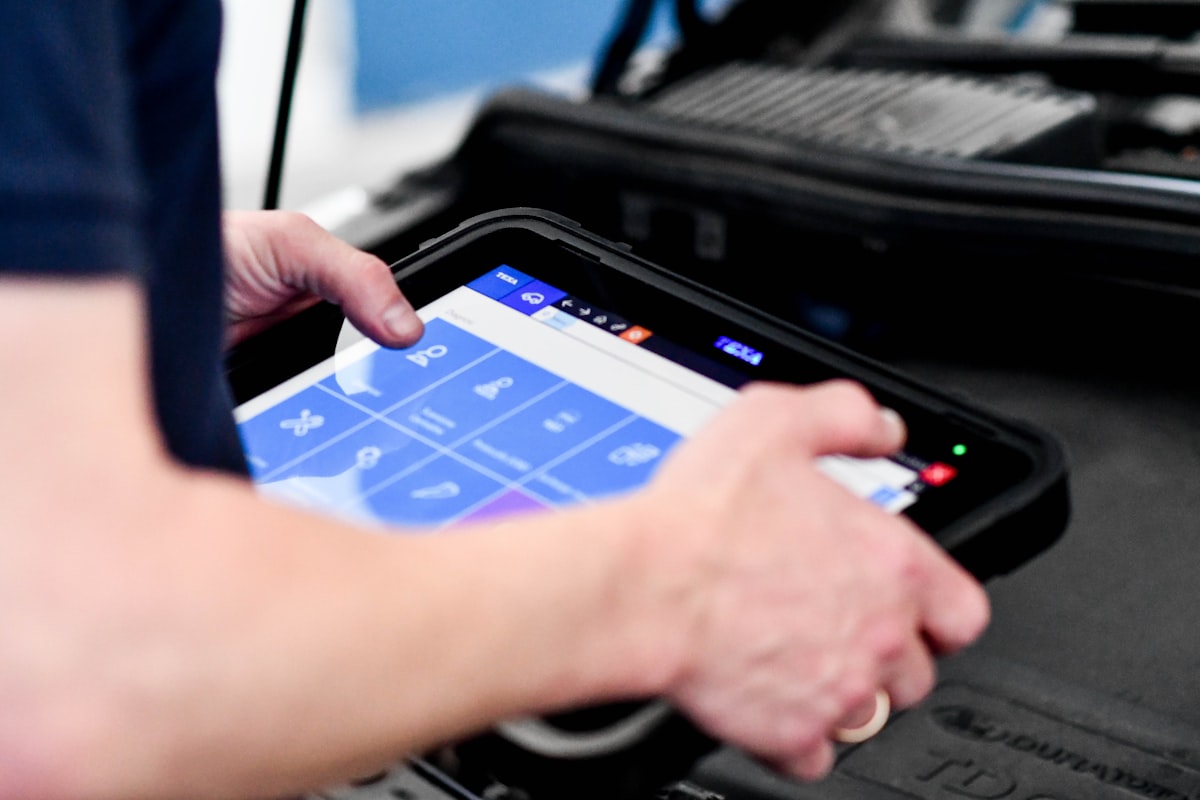
All EVs have a standard OBD2 port, usually located under the dashboard on the driver's side. The same port your mechanic uses on a petrol car. You plug in a Bluetooth OBD2 dongle, open a compatible app on your phone, and the car's Battery Management System transmits real data: SOH, individual cell voltages, and temperature readings.
The tool selection matters. As OBDadvisor puts it: "The most important data, including battery cell voltages, State of Health, isolation resistance, and inverter temperature, is all locked behind manufacturer-specific protocols that generic scanners cannot access." A cheap ELM327 clone from Computer Village may connect but will not read EV-specific data. It can also drain the car's 12V battery when left plugged in.
The reliable options:
- Veepeak OBDCheck BLE+ or Vgate iCar Pro Bluetooth dongles: N33,000-N58,000. Both are consistently recommended for EV compatibility and will not damage your battery system.
- Car Scanner ELM OBD2 app (iOS and Android): Free for basic use, N10,000 one-time Pro unlock. Supports Hyundai Kona EV, Kia Niro EV, Ioniq 5 and 6, VW ID.4, Nissan Leaf, and many more. Reads SOH, SOC, individual cell voltages, and BMS temperature data.
- LeafSpy Pro (Nissan Leaf only, iOS and Android): N25,000. The gold standard for Leaf diagnostics. Reads SOH percentage, all 96 cell-pair voltages, battery amp-hour rating, internal resistance, and full charge cycle count. Given that the Nissan Leaf is one of the most common tokunbo EVs in Nigeria, this app is worth knowing about.
- VDS2100 or XTOOL D9EV professional scanners: N660,000-N990,000. Dealer-grade tools that support BYD-specific diagnostics including cell balance, temperature monitoring, and SOH analysis. Workshop investment, not a buyer's tool.
For BYD vehicles specifically, OBD2 app compatibility is less settled than for Nissan or Hyundai. The BYD Atto 3 has OBD2 documentation in the Open Vehicles project, but what Car Scanner can actually read on the Atto 3, Dolphin, and Seal in Nigeria has not been independently confirmed. The safest path for a BYD is the Lagos showroom diagnostic or the XTOOL D9EV.
SOH buying thresholds for Nigerian conditions
These numbers should sit in your head before you visit any market. Global guidance says the high 80s is a comfortable target. In Nigeria, with sustained heat and only 12 public charging points nationwide, be stricter.
| SOH Range | Condition | What to do |
|---|---|---|
| 95-100% | Excellent. Minimal degradation. | Buy with confidence if the price is fair. Expect to pay a premium. |
| 90-94% | Healthy. Typical for a 2-5 year old EV with normal use. | Good buy. Negligible real-world range loss. |
| 85-89% | Acceptable globally. Minimum recommended for Nigeria. | Negotiate price to reflect the loss. Still a solid used EV. |
| 80-84% | Borderline. Noticeable range reduction, especially in Nigerian heat. | Only buy if the price reflects it significantly. Check the usage history carefully. |
| 70-79% | High risk. Significant range reduction. | Negotiate hard. Budget for potential battery costs within 3-5 years. |
| Below 70% | Avoid. At or below BYD's own warranty trigger threshold. | Walk away unless the price is dramatically low and you understand the implications. |
To put the 80% threshold in concrete terms: a car originally rated 400 km at 80% SOH delivers 320 km. Lagos heat and stop-start traffic subtract another 15-17% from that. Real usable range is around 265-275 km. That is a narrow margin in a city with 12 public charging points. Recharged.com put it plainly: "For most shoppers, a used EV with SoH in the high-80s or better represents a comfortable target. Below that, it can still be a good deal, but only if the discount reflects the reduced range."
The BYD Blade Battery advantage
If you are buying a BYD, there is good news on battery chemistry. BYD's Blade Battery uses LFP (Lithium Iron Phosphate) chemistry rather than the NMC chemistry found in many other EVs. LFP batteries can be charged to 100% regularly with no meaningful risk to long-term health. NMC batteries are typically recommended to stay at 80% daily to slow degradation.
BYD's warranty covers 8 years or 125,000 miles. If the battery's SOH falls below 70% during that period, BYD will repair or replace the pack. The Lagos showroom, with official diagnostic capability, is where that warranty claim would be processed. Keep your purchase documentation.
For other EV brands with NMC chemistry, the daily charging sweet spot is 20-80%. Geotab's data shows degradation only accelerates significantly when a vehicle spends more than 80% of its total time above 95% or below 5% SOC. Standard 20-80% daily practice has minimal additional impact on longevity.
What These Cost on ChargeWay
You do not have to navigate the import process alone. ChargeWay sources quality tested used EVs direct from China at wholesale pricing. Every vehicle is properly inspected before it ships. Here is what you could pay right now:
| Model | FOB Price | Est. Landed Price | Range |
|---|---|---|---|
| BYD Seagull | $10,000 | ~N18,500,000 | 305 km |
| Neta V | $12,000 | ~N22,000,000 | 380 km |
| BYD Dolphin | $16,000 | ~N28,000,000 | 427 km |
These are estimated wholesale prices for quality tested vehicles, shipped direct from China. No middleman markup, no dealer premium. Final prices depend on current exchange rates at time of order. Visit chargeway.africa/cars for live pricing and available stock.
Related Articles
Common EV Problems in Nigeria and How to Fix Them
Harmattan dust, NEPA outages, and Lagos salt air create EV problems you won't find in any European owner's manual. Here's what actually goes wrong, and what to do about it.
8 min read
MaintenanceHow to Care for Your EV Battery in Nigeria's Heat
Nigeria's sun sits well above the 30°C threshold where lithium-ion batteries begin to degrade faster. Here's the exact playbook for keeping your battery healthy in Lagos and Abuja.
7 min read
MaintenanceEV Insurance in Nigeria: Best Cover for Your Electric Car
Standard motor insurance was not built for a car where the battery alone can cost over N10 million. Here is what Nigerian EV owners need to know before signing any policy.
7 min read