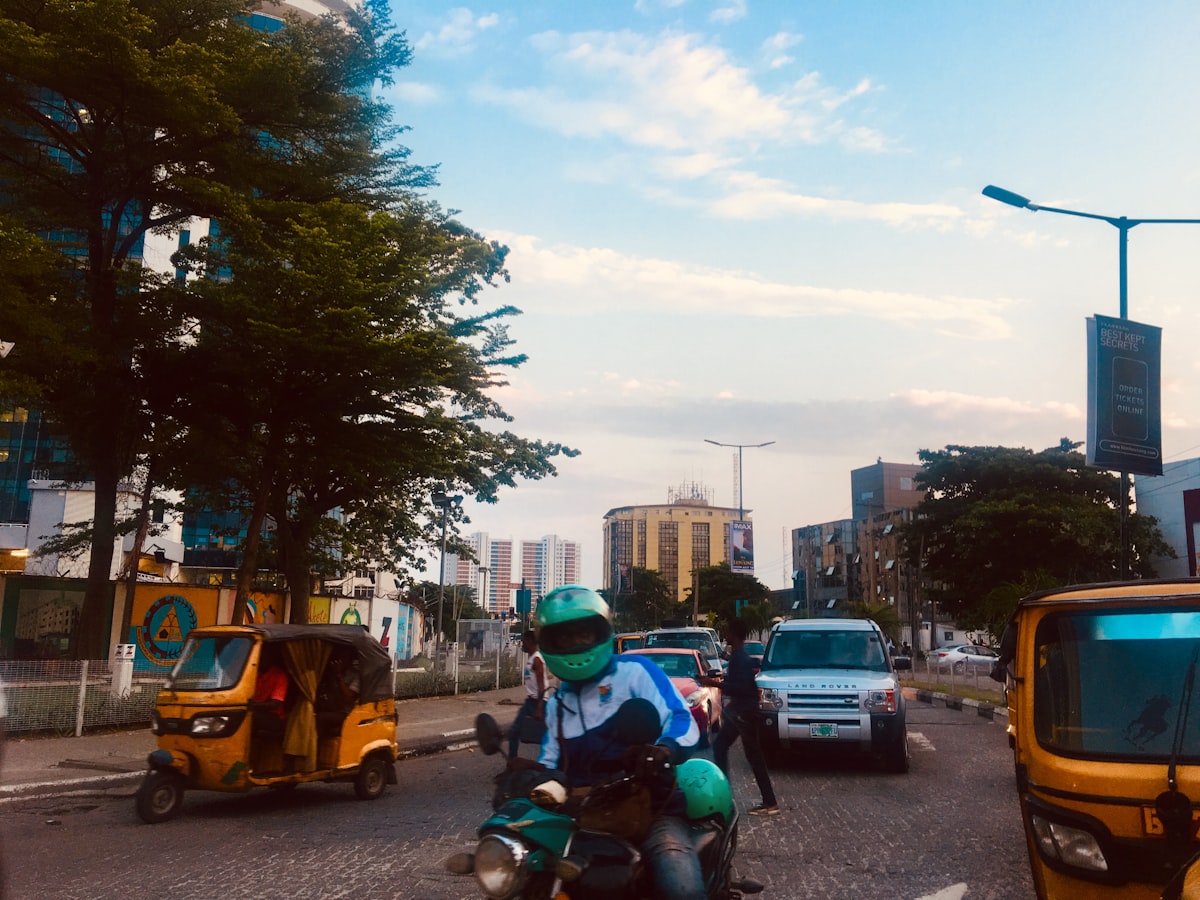
Best EVs for Lagos Traffic: Real Costs, Real Range
Lagos is the world's most congested city. But the gridlock that drains your petrol tank is quietly recharging an EV battery. Here are the best EVs for it.
Stuck at Ojota. Again.
It is 7:45 AM. You have barely moved since you joined the expressway. The fuel gauge is ticking down, the AC is working overtime in 31-degree heat, and you are calculating whether you can reach the office without joining that petrol queue where the line is longer than the traffic you just left. This is not a bad day in Lagos. This is Tuesday.
Now picture the same morning in an electric vehicle. The battery reads 87% because you pre-cooled the cabin while it was still plugged in at home. Every time you crawl to a stop and touch the brakes, the motor runs in reverse and feeds energy back into the pack. By the time you reach Ozumba Mbadiwe, the car has recovered a meaningful chunk of what it spent getting you there. The traffic that drains every drop of petrol is, for an EV, a partial recharge.
That is not marketing language. That is physics. And Lagos is one of the few cities on earth where the numbers lean this dramatically in the EV driver's favour.
Lagos Traffic: The Global Record Nobody Wanted
The 2025 Global Traffic Congestion Index ranked Lagos first in the world with a score of 365.9. Worst on the planet. Worst in Africa. The average traffic speed across the city sits at 17.2 km/h, with 60% congestion on major routes at peak hours.
Lagos commuters lose an average of 4 hours every single day to traffic. That is roughly 30 hours per week, or about 75% of a standard working week. The Lagos State Government estimates this costs the state between N3.8 and N4 trillion annually in lost productivity.
For petrol drivers, those 4 hours are money bleeding out of the tank. For EV drivers, slow stop-start movement is exactly where the technology earns its keep.
Why Lagos Traffic Is Actually Good for EVs
Regenerative Braking: The Physics Lesson Worth Knowing
Every time a conventional car brakes in traffic, kinetic energy turns into heat and vanishes through the brake pads. An EV does something different. The motor runs as a generator, converting that braking energy back into electricity and pushing it into the battery.
In purely urban driving, regenerative braking recovers approximately 14% of propulsion energy. On a motorway where you rarely brake, that drops to just 3%. Research from ScienceInsights puts the total range improvement from regenerative braking in city traffic at 10 to 25% more range compared to non-regenerative driving. An AAA study found one-pedal driving (maximum regeneration) delivered 11.3% higher real-world efficiency on stop-and-go routes versus standard blended braking.
The car you drive in Lagos traffic gets meaningfully more range out of every full charge than the same car would on an open highway. The Lagos commute is, by accident, close to ideal conditions for an EV.
The AC Question: Honest Numbers
It is not all good news. Lagos runs between 28C and 33C year-round, with average humidity of 83%, peaking at 87% in June. You will run your AC constantly. That matters.
Recurrent Auto analysed data from 29,716 EVs and found that at 32C, AC reduces range by approximately 5%. Push to 37C, which Lagos touches in the dry season, and that rises to 17 to 18%. Fleet data from Lagos EV operators puts AC drain at roughly 1% of battery every 3 minutes in tropical conditions.
The fix is simple. Initial cabin cooling from a hot-parked car requires 3 to 5 kW of power. Maintaining a comfortable temperature costs only around 1 kW. Pre-cool the car while it is still plugged in at home and you absorb that spike from the grid, not the battery. One habit, real range savings.
Lithium-ion packs operate most efficiently between 15C and 35C. Above 35C, batteries begin to discharge faster and lose storage capacity over time. Lagos regularly grazes that upper limit. The EVs listed below were selected partly because their thermal management systems handle tropical conditions better than cheaper alternatives.
The Best EVs for Lagos Right Now
BYD Atto 3: The Benchmark for This City
BYD officially entered Nigeria in March 2025 through LOXEA Nigeria, a CFAO Mobility subsidiary, opening a showroom and charging station on Victoria Island. The Atto 3 has become the reference point for serious Lagos EV buyers.
The specs that matter: a 60.5 kWh Blade Battery, WLTP range of approximately 420 km, and real-world range of 350 to 380 km in warm conditions. BYD's Blade Battery uses lithium iron phosphate chemistry, which handles heat and deep cycling better than standard lithium-ion. For Lagos's combination of persistent heat, long daily use, and uneven charging access, that is a meaningful advantage.
Price: approximately N42 to N55 million (confirm with LOXEA for current pricing) through official LOXEA channels, import duty included.
BYD Seagull: Built for This Kind of City
If the Atto 3 is out of budget, the Seagull is the smarter Lagos daily driver buy at its price point. BYD designed it specifically for dense urban environments. Traffic that chokes a petrol car is where the Seagull is most at home. E no be small thing for a car at this price.
Price: N15 to 18 million.
Hyundai Kona Electric: Locally Assembled, Proven Track Record
The Kona Electric is the first EV assembled inside Nigeria, built by Stallion Group at their VON plant. It carries a WLTP range of up to 482 km and a 64 kWh battery. Local assembly keeps landed costs lower than fully imported alternatives, and parts availability through the Stallion network is more straightforward than grey-market imports.
Price: N18 to 28 million depending on specification and source.
BYD e1: The Honest City Commuter
Not every Lagos driver needs 400 km of range. If your daily round trip is under 100 km and you charge at home every night, the e1 does the job without the premium. It is an entry-level city EV that does not pretend to be anything else. No wahala.
Price: N12 to 14 million.
Innoson IVM EX02: Made in Nigeria
Innoson launched the IVM Link and IVM EX02 on 11 September 2024. The EX02 offers a range of 330 to 400 km, making it viable for Lagos daily use. The parts-and-service argument for buying local grows stronger the older your car gets.
Price: N38.4 million.
What It Actually Costs: EV vs. Petrol in Lagos
Petrol reached N1,270 to N1,300 per litre in March 2026, up from around N600 per litre in early 2025. The commercial driver numbers from EV operators in Lagos tell the clearest story.
| Cost item | Petrol vehicle | EV |
|---|---|---|
| Weekly fuel or charging cost (commercial driver) | N150,000 to N180,000 | N30,000 |
| Annual fuel or charging savings | Baseline | N6 million+ saved |
| Public AC charging (per kWh) | N/A | N300 |
| Public DC fast charging (per kWh) | N/A | N500 |
| Cost to cover 200 km | N15,000+ at current petrol price | Approx. N4,700 at N300/kWh AC rate |
| Full commercial charge cycle (public station) | N/A | Approx. N36,000 |
EV commercial operators in Lagos report up to 40% operational savings compared to petrol equivalents. That is a real number from real operators, not a projection.
Mohammed Yunusa, a Lagos EV owner quoted by Nairametrics in February 2026, put it plainly: “My EV gives me about twice the practical range I used to get from my petrol car.” In stop-start Lagos conditions, with regenerative braking doing its work, that tracks.
The Charging Reality: Do Not Skip This Section
Nigeria has 12 public EV charging stations nationwide as of late 2025, primarily in Lagos, Abuja, and Sokoto. That number is growing, but it is low. LagRide drivers at popular Lagos stations have reported queues of up to 30 vehicles at peak times.
This is why 80% of Nigerian EV owners charge at home or at the office, according to Nairametrics data from February 2026. If you are buying an EV in Lagos today, sort your charging strategy before you sort your purchase. Can you install a wall charger at home? Can you charge at work? If the answer to both is no, you will struggle.
The picture is improving. LUG West Africa announced plans in January 2026 to install 250 solar-powered charging stations across Lagos State, each running on 7 monocrystalline solar panels generating 240V without grid dependency. SAGLEV launched Nigeria's first fully electric vehicle assembly plant in sub-Saharan Africa in Imota, Ikorodu. Nigeria's Electric Vehicle Transition Bill 2025, which passed a second reading, mandates fuel stations along major corridors to install EV charging points and requires foreign automakers to source at least 30% of components locally by 2030.
Transport economist Lanre Bakare put the honest counter-argument on the table: “We cannot talk about electric vehicles in a country where many households still struggle to get four hours of electricity per day. Until we solve power, EVs will remain luxury toys for the elite.” That is a fair challenge. Nigeria's grid generates 4,000 to 4,500 MW daily against an estimated demand of 30,000 MW. Home solar and inverter setups are how most Lagos EV owners manage it today.
What These Cost on ChargeWay
You do not have to navigate the import process alone. ChargeWay sources quality tested used EVs direct from China at wholesale pricing. Every vehicle is properly inspected before it ships. Here is what you could pay right now:
| Model | FOB Price | Est. Landed Price | Range |
|---|---|---|---|
| BYD Seagull | $10,000 | ~N18,500,000 | 305 km |
| BYD Dolphin | $16,000 | ~N28,000,000 | 427 km |
| BYD Atto 3 | $22,000 | ~N38,000,000 | 420 km |
These are estimated wholesale prices for quality tested vehicles, shipped direct from China. No middleman markup, no dealer premium. Final prices depend on current exchange rates at time of order. Visit chargeway.africa/cars for live pricing and available stock.
Related Articles
Best 7-Seater EVs You Can Import to Nigeria in 2025
Nigeria's average household is 5 people before you count the uncle who always needs a lift. Here is your complete guide to the three 7-seater EVs worth importing right now, with real landed costs.
7 min read
Buying GuideThe 5 Best BYD Models for Nigerian Roads in 2025
BYD finally has an official Nigerian dealer. We rank all five models by what actually matters: ground clearance, price in Naira, and real-world range.
7 min read
Buying GuideBest EVs Under $20,000 for Nigerian Buyers in 2025
Budget EVs from China are landing in Nigeria. Here is what the BYD Seagull, Neta Aya, and Chery iCAR 03 actually cost once they clear Apapa port, and which one makes sense on a Nigerian road.
7 min read